Living rulebook
Turin Market
TURIN MARKET
- Players
- 2-5
You are a goods trader in the 18th century city of Turin, Italy. There is a food revolution underway, with families and traders fighting for control. Only the most powerful and cunning trader of each good can rise to the top and monopolize the market!
- AGES: 8+
- OBJECTIVE: To have the most Scudo at the end of the game.
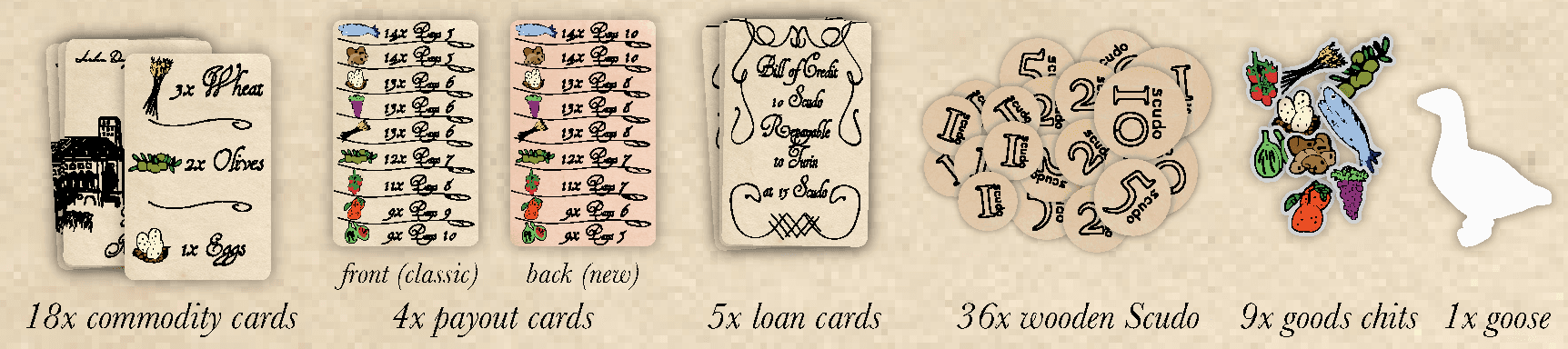
- PIECES: 18 commodity cards, 5 loan cards, 4 goods payout cards, 36 wooden Scudo in multiple denominations, 9 leader chits, 1 goose.
Each commodity card consists of 3 of one good, 2 of a different good, and 1 of another. The total number of goods for each type is shown next to the good of that type on the payout card.
SETTING UP
Give each player 15 Scudo. Give players a payout card. Before play begins, players choose to score using the classic version or the new version (in red) on the payout cards. Shuffle the 18 commodity cards, dealing them face down based on player count:
- 2p: 6 cards to each player. The remaining 6 are discarded without viewing them.
- 3p: 6 cards to each player.
- 4p: 4 cards to each player. The remaining 2 are placed face up in the center.
- 5p: 3 cards to each player. The remaining 3 are placed face up in the center.
AUCTIONS
A series of auctions take place in the following manner:
1 - Each player secretly chooses and places one card from their hand face down in the center of the table. Then, simultaneously reveal these cards. Note: Skip this phase during the first round in a 4/5 player game; only bid on the cards placed in the center during setup.
2 - Each player secretly chooses the amount they wish to bid for the revealed cards, keeping the Scudo hidden in a closed fist. Then, all players simultaneously reveal their bids.

Rules for bidding:
- Winning bids must pay their entire bid amount to the bank.
- Losing bids must pay half of their bid rounded down to the bank.
- Players do not have to bid any Scudo; however they may not win any cards if bidding 0.
- If players tie their bids, they immediately begin another bidding round to determine the winner. The tied players secretly choose and reveal any amount of Scudo, adding it to their previous bid. Highest bidder wins the tie. If still tied, the winner is determined by a coin toss. Here, players are only competing for their original tied position, and cannot attain a higher position no matter how high their total bid is.
- If players tie while bidding with 0 Scudo, even as a secondary bidding round to settle a tie, neither player wins. The card(s) they would have won are immediately discarded from the game. Players pay their initial bid if there was one, divided by 2 and rounded down, to the bank.
- No players choose cards until all ties have been resolved.
3 - Players choose cards to keep, beginning with the highest bidder, second highest bidder, etc... The number of cards kept is based on the number of players:
- 2p: The highest bidder wins 2 cards.
- 3p: The highest bidder wins 2 cards. The second highest wins 1 card.
- 4p: The highest bidder wins 2 cards. The second highest wins 1. The third highest wins 1. During the first round only, the 2 highest bidders choose 1 card each.
- 5p: The highest bidder wins 2 cards. The second highest wins 2. The third highest wins 1. During the first round only, the 3 highest bidders choose 1 card each.
4 - Cards won are displayed face up in front of the winning players for the remainder of the game. Each player may now attempt to sell a face-up card. To do so, players place an amount of Scudo on the card they wish to sell. The placed amount is the cost that must be paid by a potential buyer. This Scudo may not be used for bidding in the next round, and must remain on the card until it is either bought or removed by the player. Once a card is for sale, any player may buy that card at any time. The amount is paid to the selling player. If two players speak up at the same time, the seller chooses between them.
Cards won are displayed face up in front of the winning players, Scudo used for selling a card is placed on top of the card being sold for at least 1 auction round, and goods chits are placed in front of players with majority of that good for easy reference.
5 - Once every player has had a chance to put a card up for sale, the auction round is repeated until players have no cards remaining. Note: In a 2/3 player game, one card in the player’s hand will not be put up for auction. At the end of the game, the card remaining in the player’s hand is added to their face-up cards, counting toward their goods total. At the end of a round, players with a goods majority may take the matching goods chit to denote they have the most of that specific good.
EXAMPLE
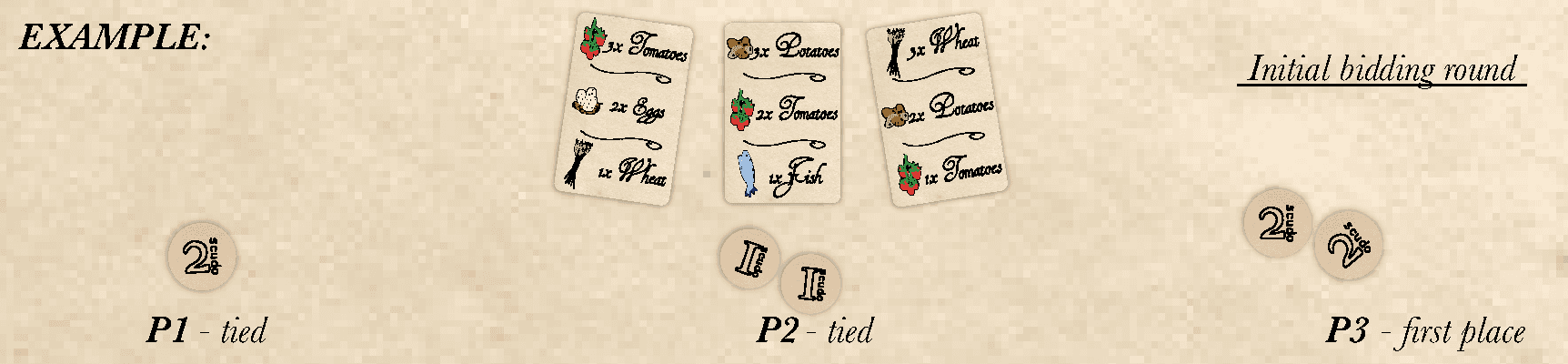
P3 bids 4 Scudo, winning with the highest bid. P1 & P2 bid 2 Scudo each, tying for second place. P3 pays their 4 Scudo to the bank and will choose 2 cards after P1 & P2 settle their tie in a secondary bidding round.
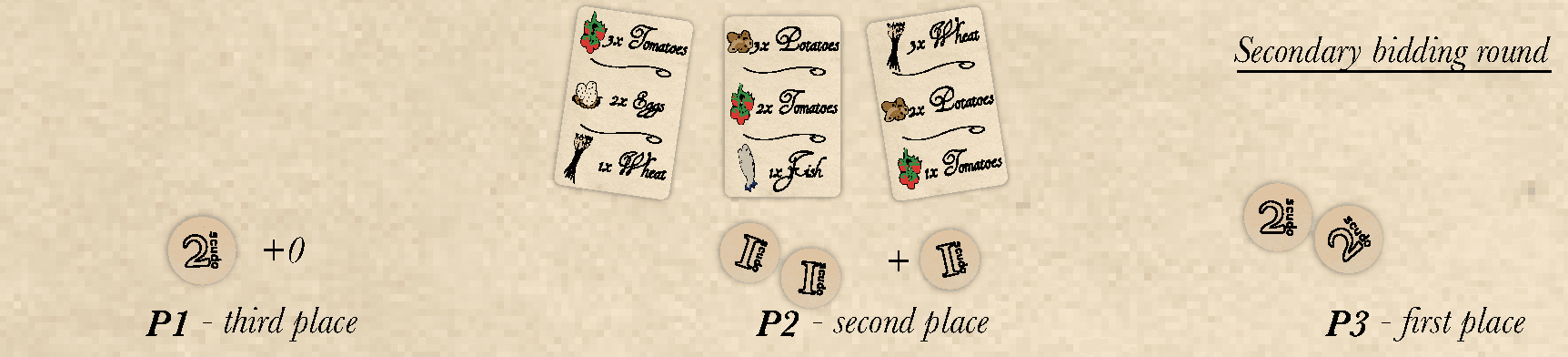
P2 adds 1 Scudo to their total bid, and P1 adds 0. P2 wins second place, and pays their 3 Scudo to the bank, taking 1 card after P3 has chosen 2 for themself. P1 still pays 1 Scudo (their new total bid of 2, divided by 2 rounded down) to the bank and takes no cards.
LOANS
Players may take out a loan at any point in the game. Loans immediately give the player 10 Scudo, but 15 Scudo must be paid back after endgame payouts. A player may only have 1 loan.
ENDGAME SCORING
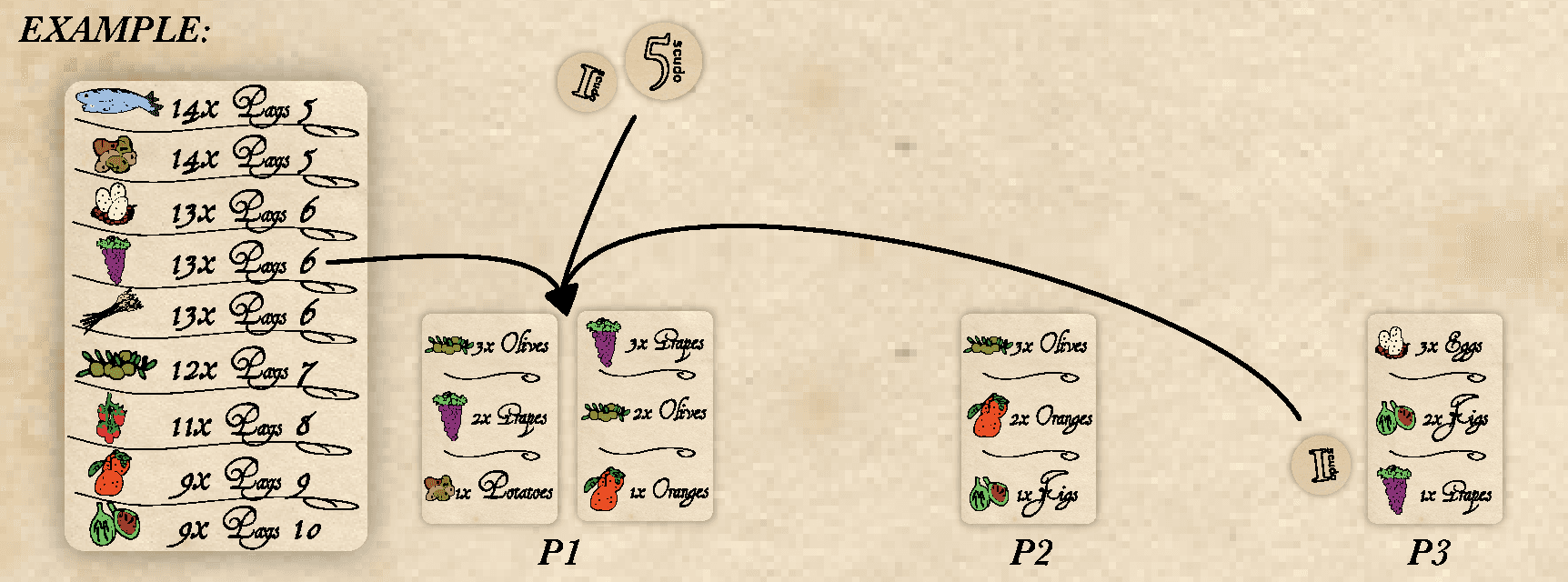
Once the final auction ends, final payouts begin. Beginning with the good at the top of the payout card, and moving downward, the bank pays the amount shown on the right of each good to the player with the majority of that good. The player with the majority of a good receives the total payout amount from the bank. In addition, each other player who has any of that good must pay 1 Scudo to the player with the good majority. If more than one player ties for the majority of a good, the players split the total payout from the bank, including payouts from all other players with any of that good. Divide the total by number of tied players, rounding up.
If a player needs to make the 1 Scudo payment to another player, but does not have any Scudo, they must then take out a loan. If they already have a loan, the bank makes the payment for them. The player takes 2 Scudo from the bank and places it on their loan card. They must pay the 2 Scudo, in addition to the 15 Scudo loan, after payouts complete.
P1 has the most grapes and receives 6 Scudo from the bank, along with 1 Scudo from each player with any grapes.
After the final goods payout, players with loans must pay back their loan to the bank at 15 Scudo per loan.
The player with the most Scudo remaining wins!
OPTIONAL RULES
- For a more competitive and longer experience, play 3 games in a row, keeping track of end game scoring. Highest total of Scudo wins.
- Scudo may be kept secret or public, as long as all players agree before the game begins.
THE BARTERING GOOSE
The bartering goose is a special token that can be used in any way the group sees fit! It’s up to you to come up with the rules for the goose, should you choose to play with it. Some examples might include:
- When players tie, one of them can speak up and take the goose. They lose the bid and thus the tie. Later when that player is in another tie, they may give the goose to the player they tied in order to win the tie. This continues until game end (or even into a series of games).
- The player with the least number of goods majority gets the goose (unless there are tied players), and their bids gain +1 Scudo.
CREDITS
DESIGN: JORDAN DRAPER
ARTWORK: JORDAN DRAPER
RULES EDITING: TRAVIS HILL
Special thanks to Matt Clyker for sharing his real life experience that inspired the bartering goose!
Special thanks to Heavy Cardboard for trying this game out, and as a consequence saving it from the grave!
FAQ
May players sell cards after the final auction, before final scoring? No. Once the final auction ends, final payouts begin immediately, so there is no window to offer or buy cards for sale after the last auction concludes.
What counts as a winning bid, and what do winning and losing bidders pay? A bid wins if it gains you at least one card from the auction. Winning bids pay their entire bid amount to the bank; losing bids pay half of their bid rounded down to the bank, so a losing bid of 1 Scudo pays nothing.
How many cards can you offer for sale at once, and how long does a card stay on sale? Each auction round you may attempt to sell one of the cards displayed face up in front of you, placing Scudo on it as its price. The card stays on sale until it is bought or you remove it; the placed Scudo must remain on the card for at least one auction round and may not be used for bidding in the next round, and when you take the card off sale the Scudo returns to you.
Does the rule discarding cards when players tie a bid at 0 Scudo apply at every player count, and what happens if players tie for the most Scudo at game end? Yes: whenever players tie while bidding with 0 Scudo, even in a secondary bidding round, neither wins and the cards they would have won are immediately discarded, at any player count. Players tied for the most Scudo at game end share the victory.
The goods payout order differs between the large payout card and the small player aid cards; which is correct? The order on the large tarot sized payout card is official; the small player aid cards carry a misprint. Payouts resolve from the good at the top of the payout card downward, though any order works if all players agree on it before the game.
Does the Scudo placed on a card you offer for sale come from your own supply, and do you get it back when the card sells? Yes, the Scudo comes from your own money. If another player buys the card, you receive their payment and take back the Scudo you placed on it.
If two players tie for the majority of a good at final scoring, who receives the bank payout and the other players' payments? The tied players split the total payout: the bank amount plus the 1 Scudo paid by every other player holding any of that good, divided by the number of tied players and rounded up. With a 6 Scudo bank payout plus 1 Scudo from a minority player, two tied players take 4 each.
In a four player game, if the two highest bidders then tie at 0 Scudo in the secondary bidding round, what happens to the cards and the other bidders? Neither tied player wins: all cards they would have won are discarded (two for first place and one for second, with a coin toss deciding who counts as which), and each tied player pays half of their initial bid rounded down to the bank. The third highest bidder still takes the remaining card for their original position, and the lowest bidder pays half their bid rounded down and takes nothing.