Living rulebook
Tokyo Jutaku
TOKYO JUTAKU
- Designer
- JORDAN DRAPER
In TOKYO JUTAKU you take on the role of a famous or emerging Japanese architect with the goal of building small homes on a strangely-shaped or limited-sized property. In real-time dexterity, players will use geometric pieces to build these homes, all while meeting specific building requirements, such as floor count and quantity of building materials.
CONTENTS
- 36 - Square Site Cards
(The 4 Roppongi site cards are bonus advanced cards that can replace any other district)
- 68 - Unique Wooden Pieces
- 8 - Circular Architect Player Tokens
- toyo ito
- tadao ando
- shigeru ban
- kengo kuma
- makoto yokomizo
- ryuji fujimura
- sou fujimoto
- go hasegawa
STARTING THE GAME
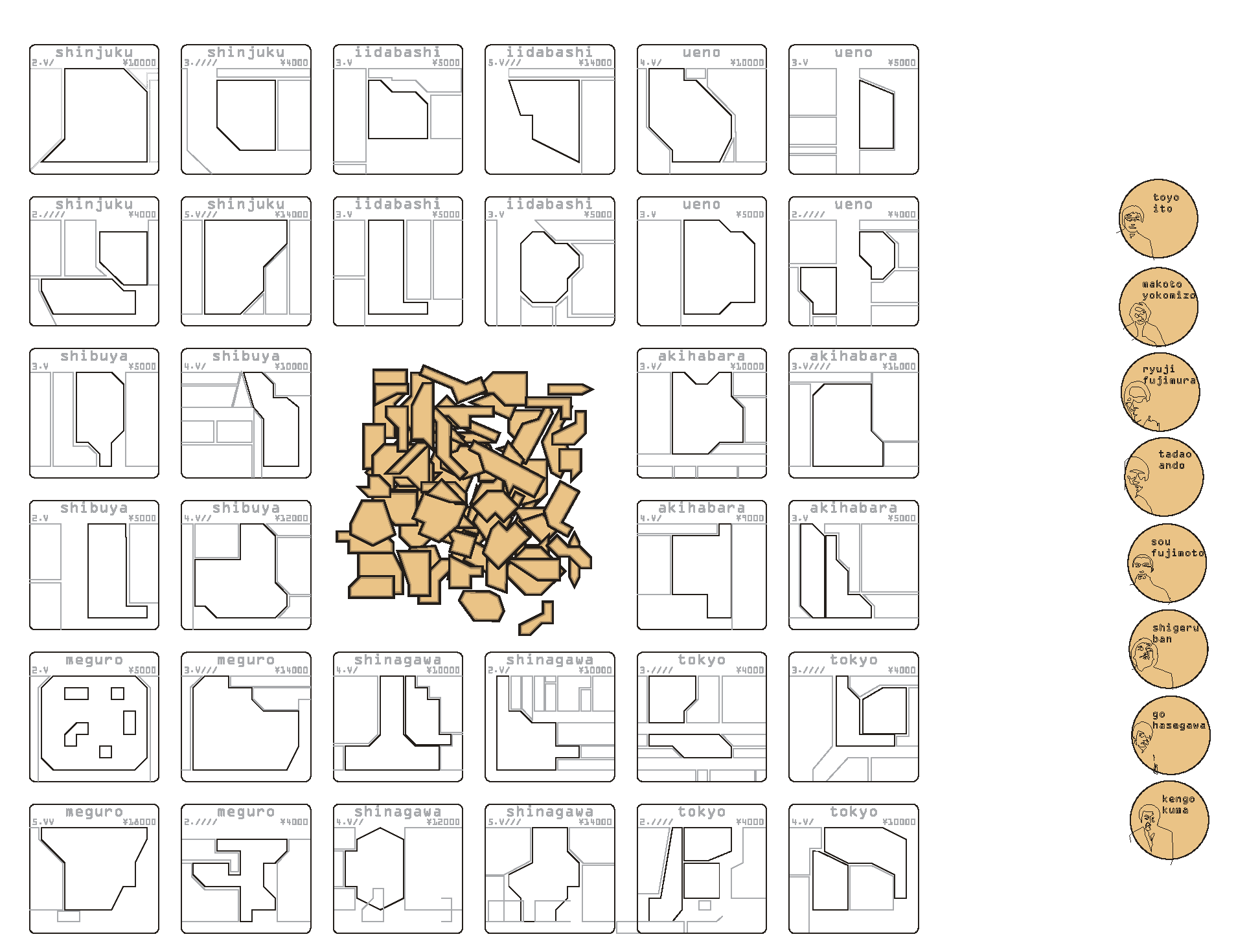
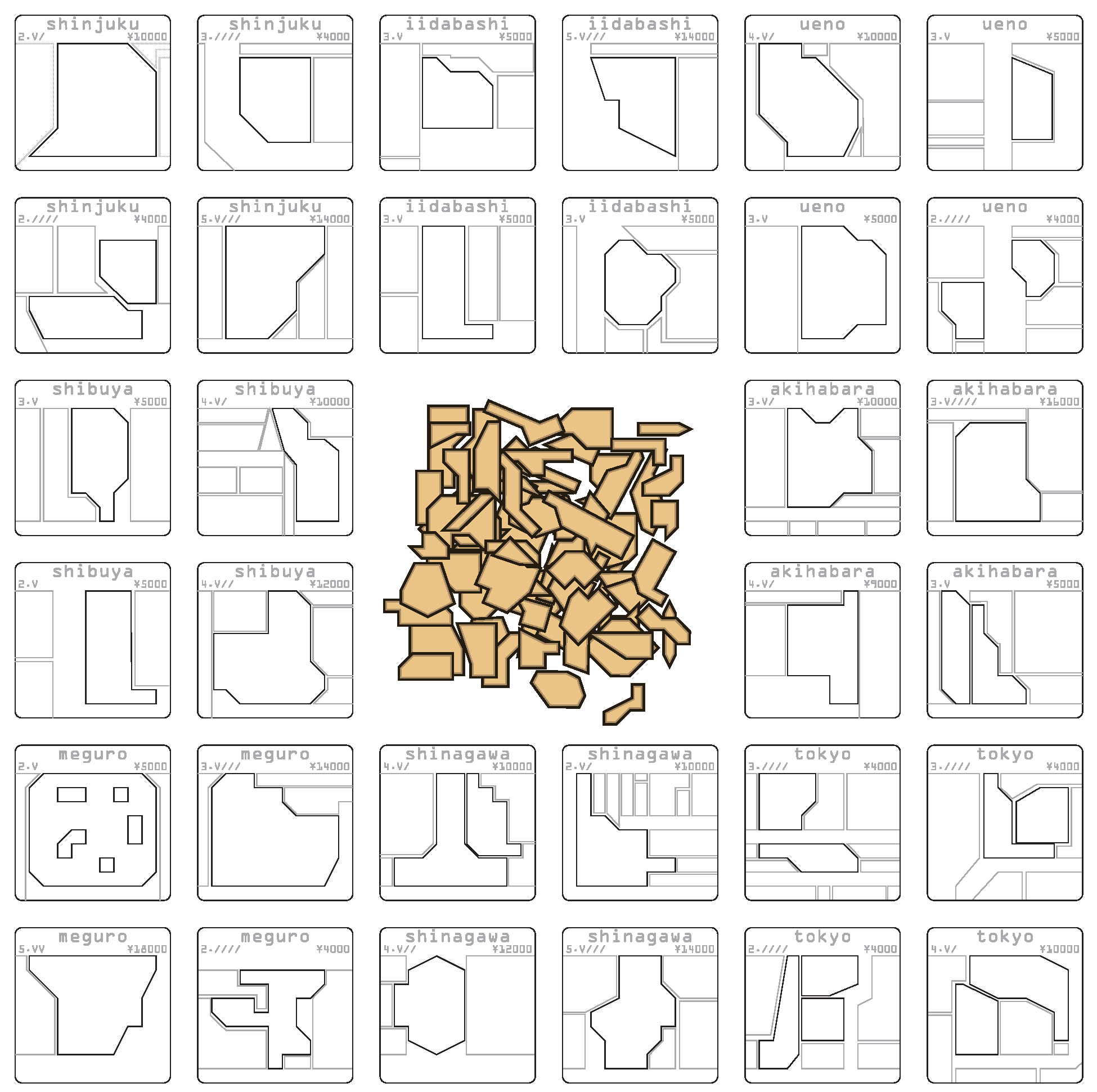
Each site card displays at the top a location in Tokyo City. Place the 32 site cards into a 6x6 grid, grouped by their locations. Place the wooden building pieces where the center 4 cards would be.
Objective: to accumulate the most yen (¥) before the game ends.
Game End: when any player has completed 4 building sites.
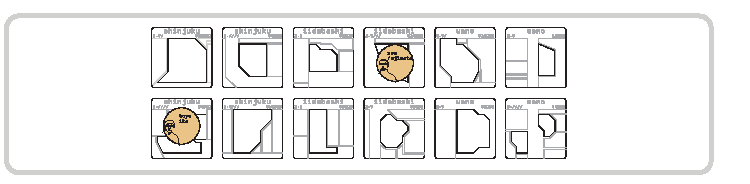
Starting The Game: each player chooses one architect token and places it on one site card on the outer perimeter of the map.
Players take the site card beneath their architect token and place it in front of them, leaving the architect token where it is. Someone says ‘begin’ and all players start building!
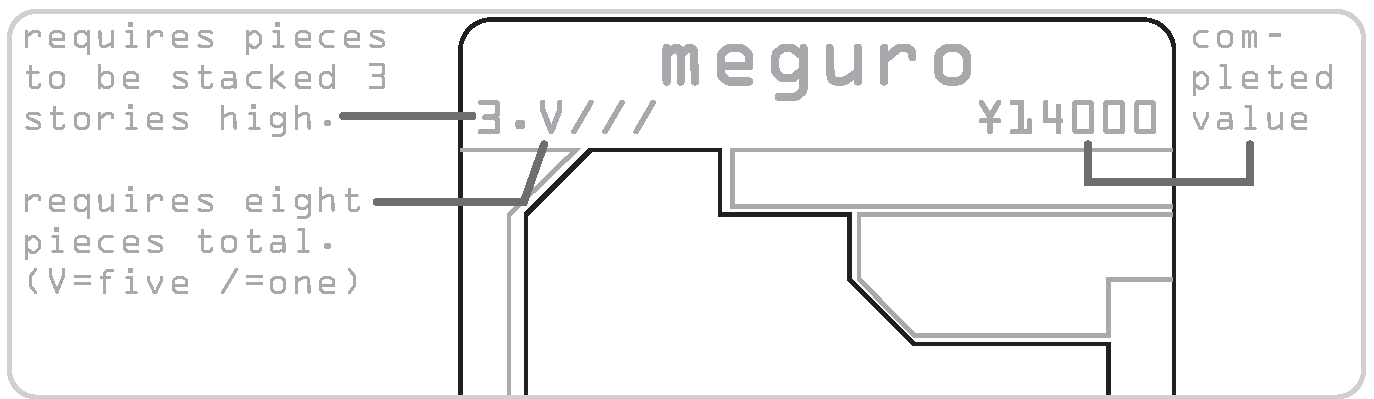
Building Requirements: Each site card contains a number for the height requirement and a roman numeral value for the number of pieces that must be used.
- 3; requires pieces to be stacked 3 stories high.
- V///; requires eight pieces total. (V=five /=one)
- ¥14000; completed value.
Building Sites: Building sites have a black border. This is the boundary that all levels of the building must stay within. If a site has two black borders, the player may choose which of the two to build on.
Building Rules: All at once, players select one piece at a time, and place it on their site card.
Players may flip and rotate the piece however they like before placing.
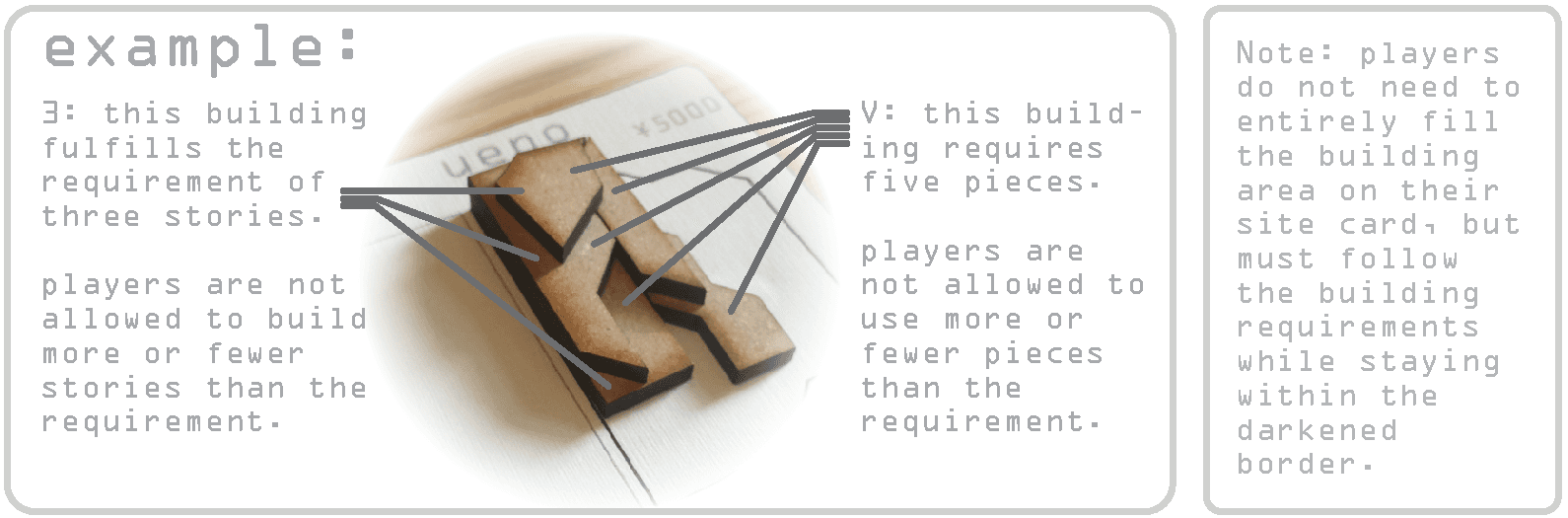
example:
- 3: this building fulfills the requirement of three stories. players are not allowed to build more or fewer stories than the requirement.
- V: this building requires five pieces. players are not allowed to use more or fewer pieces than the requirement.
Note: players do not need to entirely fill the building area on their site card, but must follow the building requirements while staying within the darkened border.
Instead of selecting and placing a new piece, players may return the recently-placed piece from their building back to the supply. All pieces may be returned to the supply one at a time if desired.
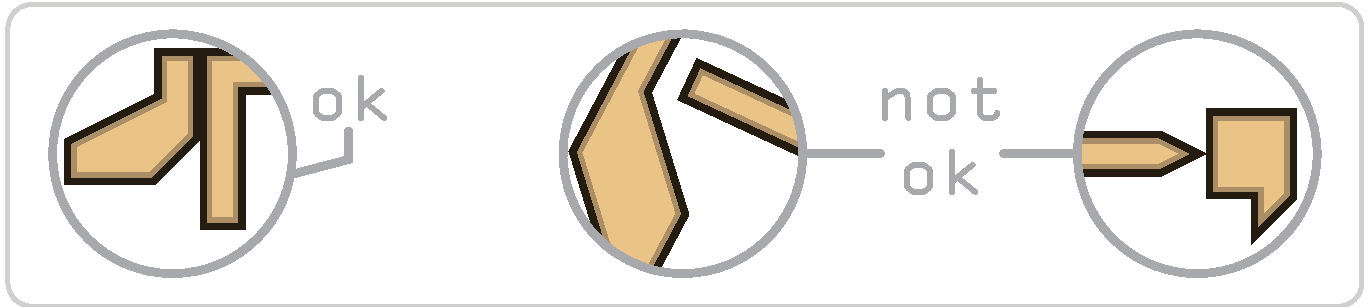
Pieces must be placed within the darkened site border. When building multiple pieces on the same floor, at least one side must touch another piece.
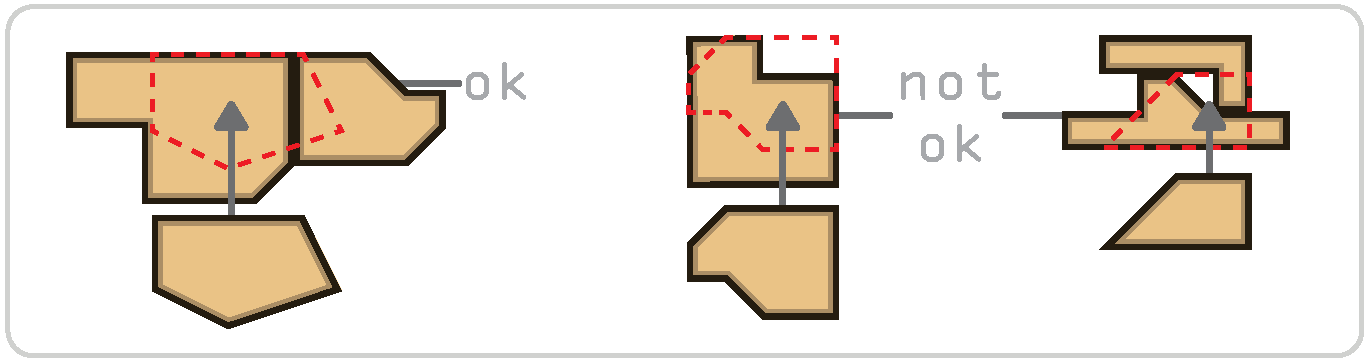
When stacking pieces, it is not allowed to place pieces outside of the boundaries of the previous level, or over any gaps.
Building Completion: When any player thinks they have successfully completed a building, they say ‘stop!’ Everyone pauses their building and checks to see if all requirements were met, deconstructing it if necessary. If the player did not fulfill all requirements, everyone continues building until another player says ‘stop!’ If the requirements were met, that player keeps their site card for its yen value, and everyone returns all pieces on their site card to the center of the map. If multiple players say ‘stop’ at the same time, all successfully-built site cards are completed and kept for scoring.
MOVEMENT
The player who successfully completed their building moves their architect token up to two spaces away; diagonal movement is not allowed. If there is a gap, simply move through that space as if it did not exist. This continues clockwise until all players have moved. If a player did not complete a building, they may keep their same site card instead of moving. If multiple players successfully built site cards during the building round, the player with the most yen moves their architect first.

GAME END
Once a player finishes their fourth site card, the game ends. Everyone adds up their total yen (¥) from completed site cards and whoever has the most is the winner! If players tie, the victory is shared.
COUNTDOWN
- Players
- 1-8
- Time
- 5 minutes
Countdown is an extra game included with TOKYO JUTAKU that uses the same pieces.
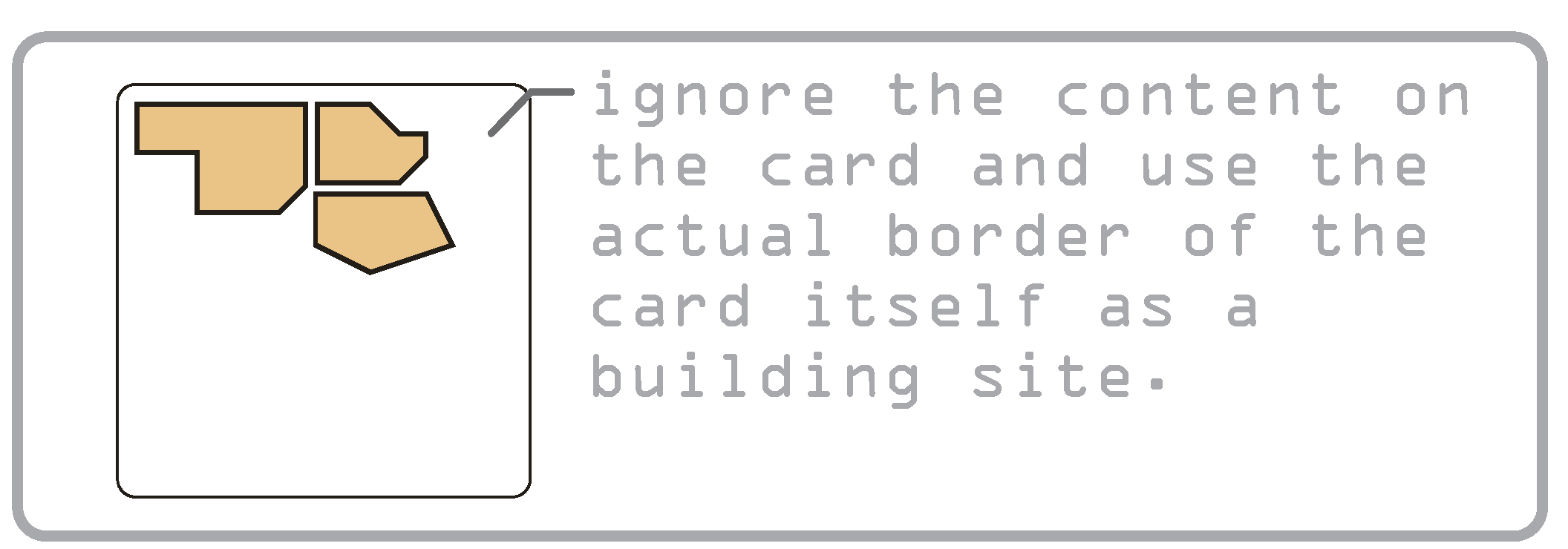
Setup: Each player takes any one card. Ignoring the darkened site border and using only the edges of the card itself, they will build a succession of floors.
How to Play: Using the same building rules as TOKYO JUTAKU, players will build as many pieces as they can onto each floor, within a succession of timed rounds.
ignore the content on the card and use the actual border of the card itself as a building site.
- 1st Floor: 60 Seconds
- 2nd Floor: 45 Seconds
- 3rd Floor: 30 Seconds
- Further Floors: 15 Seconds
When a player fails to add any pieces in one of the timed rounds, their game is over. They count up the total pieces used and that is their score. The remaining players continue until all are out.
BOTTLE BONUS!
- Players
- 2-8
- Time
- 20-30 min
BOTTLE BONUS is a variation of TOKYO JUTAKU that uses pieces from JIDOHANBAIKI.
This game plays exactly as TOKYO JUTAKU does. After each round ends, before moving, the player who completed their building from the round will take a number of drinks randomly from the box equal to the number of other players. They will then drop those drinks into the vending machine all at once, and all other players may grab up to 1 drink that comes out of the vending machine.
These drinks now grant a special one-time use power to the players who grabbed them, based on the specific drink color as follows:
BLACK: Spend this drink to flip over your site card before you start building on it. Players cannot look at the back side before deciding to flip or not.
WHITE: Spend this drink and then place 1 piece on your site card before the round begins.
MINT: At any time during the round, spend your mint drink and yell ‘put it back’. All other players must put back the piece they are currently using, or the last one they placed, and take a different piece from the supply.
BLUE: Spend this drink before one round of building. If you win that round, keep this drink next to your site cards for +200 yen (¥) at game end. If you do not win this round, discard this drink.
RED: Spend this drink to move 2 pieces at the same time for this round only. You will still only grab one piece at a time, but you may freely arrange it and one other piece on your building simultaneously.
PURPLE: During the move phase, spend this drink to move to any available site card on the map, ignoring regular movement rules.
IZAKAYA
- Players
- 2-5
- Time
- 30 min
IZAKAYA is a game about building a city with corner shops that mixes together JUTAKU, JIDOHANBAIKI, and METRO.
Setup: Shuffle the Jutaku cards and create a grid based on the number of players. Use the more difficult white side.
- 2-3 Players: Create a 3x3 grid. flip the center card to the blue side - it cannot be used.
- 4 Players: Create a 4x4 grid
- 5 Players: Create a 5x5 grid
Place one site card on its easy blue side to the left of the grid. Place all Jutaku pieces above the grid, and one architect token to the side of them. Take all 6 of the color stock cards from JIDOHANBAIKI, and place them in a row below the grid. Then, place a crate below each stock card, filled with all 6 drinks of that specific color.
Place one of the shape stock cards from JIDOHANBAIKI face down to the right of the row. Place 100 yen coins on the left two color cards, 200 yen on the middle two color cards, and 300 yen on the right two color cards. Give each player 6 pyramids and 9 matching discs of the same color from METRO, and 1,000 yen. Using players’ remaining disc, randomly draw them 1 at a time, and create a turn order row next to the grid.
only three of the nine discs will be used to take actions with.
Gameplay: The game consists of two phases: bidding for turn order and taking actions.
Bidding for turn order: Decide the amount of yen you wish to bid and secretly place it in a closed fist. All reveal simultaneously. Whoever bid highest goes first, next-highest second, etc… Adjust the turn order track, and place all yen used to bid into a separate pile. Players who tied with their bids swap positions in turn order.
Action phase: In turn order, players will place 1 of their 3 discs on an action spot:
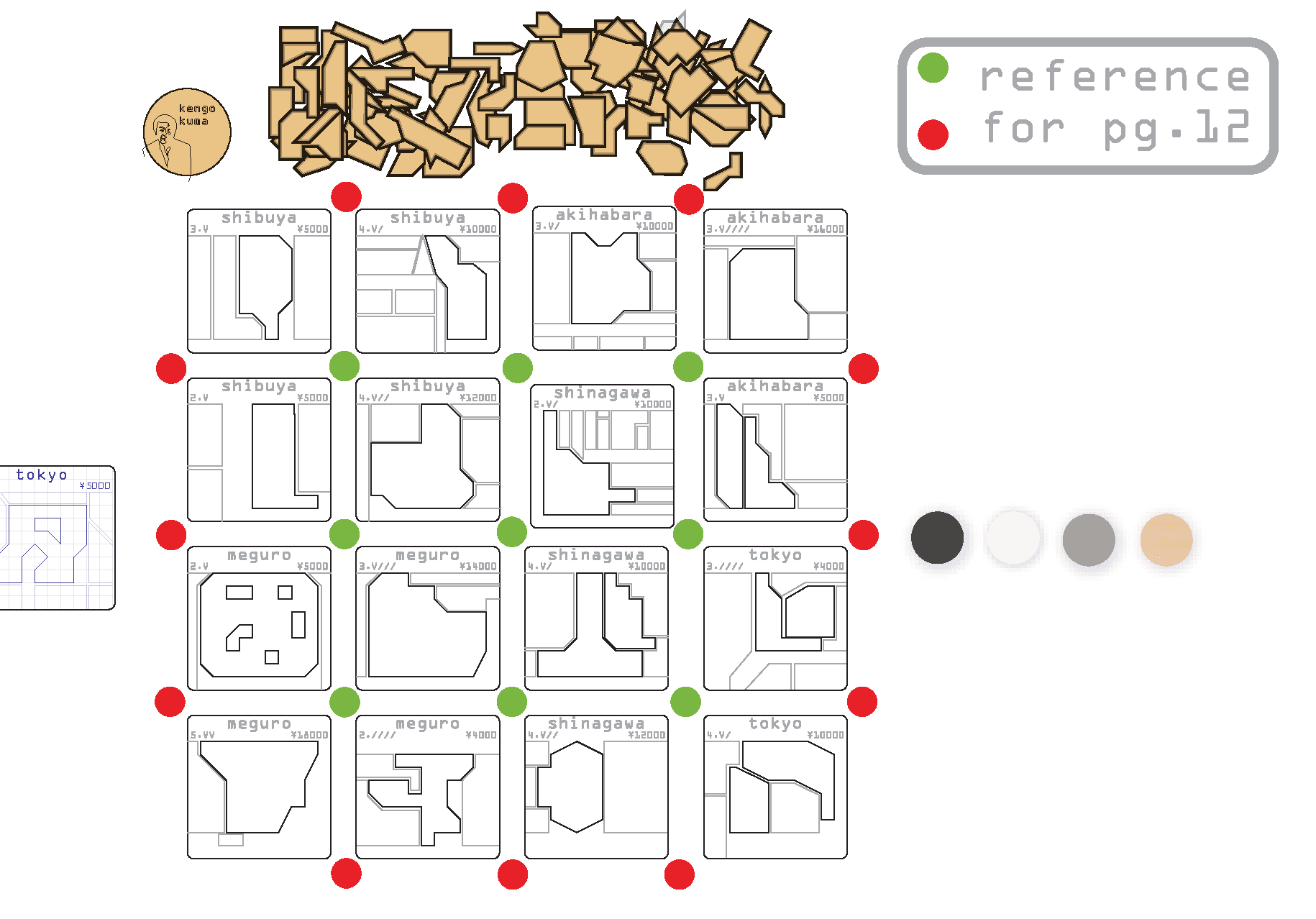
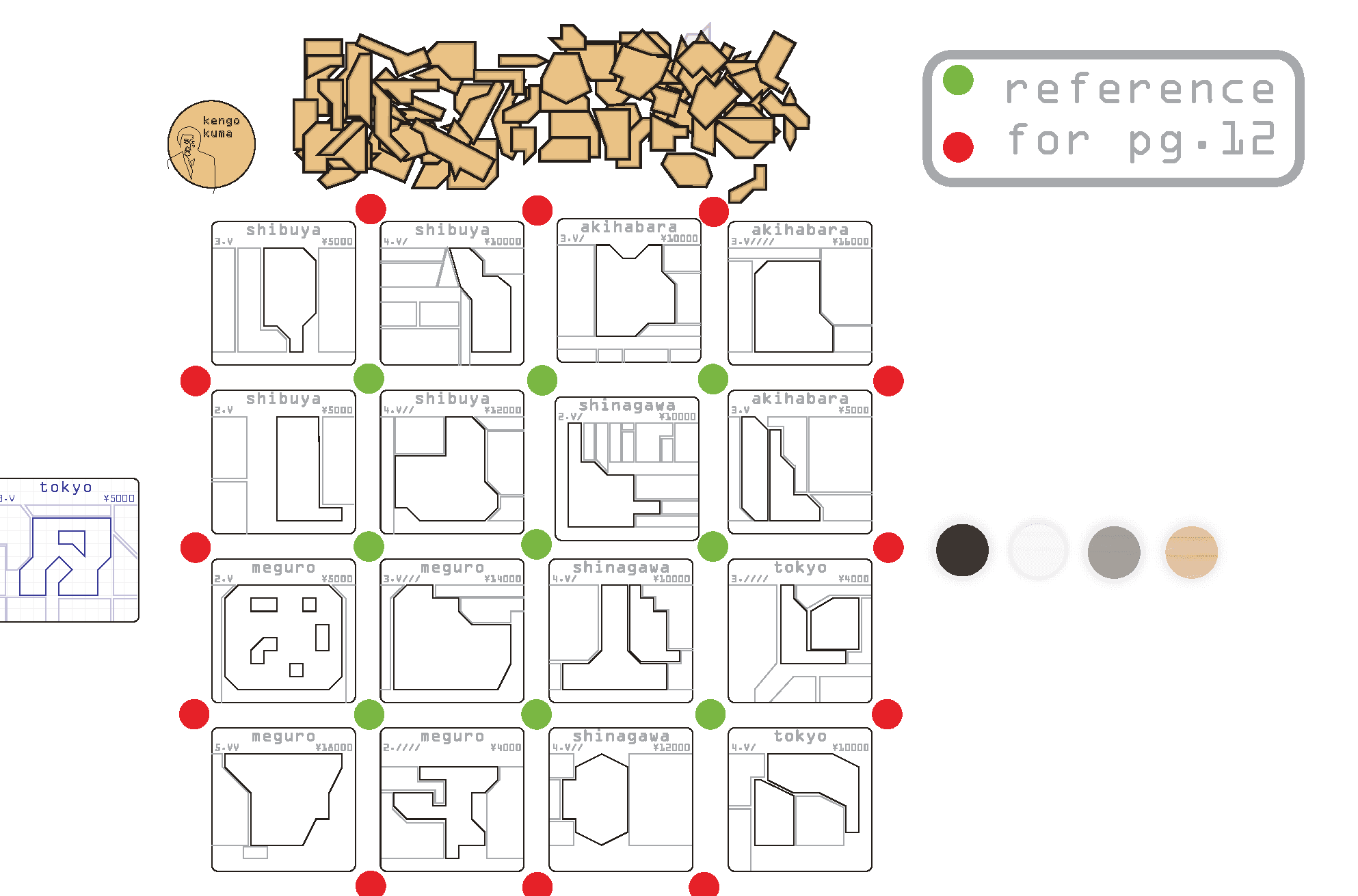
Colored bottle spot: Place your disc on a color stock card, take one of the drinks in that crate, and place it at a corner intersection between cards. Only one disc may be placed on each color per action phase. All 4 card intersection spots (shown in green on pg.11) must have drinks before any 2 card intersection spots (shown in red) may be chosen. It is never possible to place drinks on a single outside card corner that is not shared with another card.
Price adjustment spot: Place your disc on the face-down JIDOHANBAIKI card, then move a single 100 yen coin from a color stock card to a different color stock card. Only one disc may be placed on this action spot per action phase.
Site claiming: Place your disc on the blue site card. Then, place one of your six discs in the space between the edges of two site cards.
Finally, place one of your pyramids on a site card sharing a side with the previously-placed disc. Only one player may occupy each site card. There is no limit to the number of players that can use the site claiming action each action phase. If a player manages to get a straight line of 3 action discs (only possible in the 4 or 5 player games), they get to take a building piece from the supply and place it immediately anywhere they wish for free, following the normal building rules of JUTAKU.
Build action: Place your disc on the architect token, then take a single building piece (it is not allowed to test the piece out; it must be chosen first), and place it onto any site card that you wish, following the normal building rules of JUTAKU. If there are two dark site borders on a card, they may both be used as separate buildings. There is no limit to the number of build actions that can be taken each action phase.
Action round end: After all players have placed their 3 action discs and performed actions, return the action discs to their owners and begin a new auction round.
Game End: The game end is triggered when a certain amount of yen is met or exceeded while bidding for turn order. After the designated amount is reached, players take one more action phase. The game ends when the total amount of yen meets or exceeds: 1,500 yen for 2 players / 2,300 yen for 3 players / 3,000 yen for 4 players / 4,000 yen for 5 players.
Scoring: Each player scores points based off of their buildings and the values of the drinks directly adjacent to them. Sum the total yen amount of each bottle touching your building. Multiply that total with the number of floors built on your building.
Example: The grey colored player has a building with 3 floors and 3 drinks on the corners of the site card. They count up the sum total of all of the drinks touching the site card, and then multiply that by the number of floors (3). So if there were 2 white drinks (at market value of 200), and 1 blue drink (at market value of 300), the player multiplies their 3 story building by 700 yen, taking a payment of 2,100 yen. After players score all of their buildings, they add their total yen amounts as their score.
The player with the most yen is declared the winner! If there is a tie, the player who kept the most of their starting yen wins.

CREDITS
Design and artwork by: Jordan Draper
Rulebook Editing: Travis D. Hill
www.jordandraper.com
talk@jordandraper.com
IZAKAYA
- Players
- 2-5
- Time
- 30 MIN
- Designer
- JORDAN DRAPER
- Games required
- TOKYO JUTAKU, TOKYO JIDOHANBAIKI & TOKYO METRO
IZAKAYA is a game about building a city with corner shops that mixes together JUTAKU, JIDOHANBAIKI, and METRO.
Setup: Shuffle the Jutaku cards and create a grid based on the number of players. Use the more difficult white side.
- 2-3 Players: Create a 3x3 grid. flip the center card to the blue side - it cannot be used.
- 4 Players: Create a 4x4 grid
- 5 Players: Create a 5x5 grid
Place one site card on its easy blue side to the left of the grid. Place all Jutaku pieces above the grid, and one architect token to the side of them. Take all 6 of the color stock cards from JIDOHANBAIKI, and place them in a row below the grid. Then, place a crate below each stock card, filled with all 6 drinks of that specific color.
Place one of the shape stock cards from JIDOHANBAIKI face down to the right of the row. Place 100 yen coins on the left two color cards, 200 yen on the middle two color cards, and 300 yen on the right two color cards. Give each player 6 pyramids and 9 matching discs of the same color from METRO, and 1,000 yen. Using players’ remaining disc, randomly draw them 1 at a time, and create a turn order row next to the grid.
only three of the nine discs will be used to take actions with.

Gameplay: The game consists of two phases: bidding for turn order and taking actions.
Bidding for turn order: Decide the amount of yen you wish to bid and secretly place it in a closed fist. All reveal simultaneously. Whoever bid highest goes first, next-highest second, etc… Adjust the turn order track, and place all yen used to bid into a separate pile. Players who tied with their bids swap positions in turn order.
Action phase: In turn order, players will place 1 of their 3 discs on an action spot:
Colored bottle spot: Place your disc on a color stock card, take one of the drinks in that crate, and place it at a corner intersection between cards. Only one disc may be placed on each color per action phase. All 4 card intersection spots (shown in green on pg.11) must have drinks before any 2 card intersection spots (shown in red) may be chosen. It is never possible to place drinks on a single outside card corner that is not shared with another card.
Price adjustment spot: Place your disc on the face-down JIDOHANBAIKI card, then move a single 100 yen coin from a color stock card to a different color stock card. Only one disc may be placed on this action spot per action phase.
Site claiming: Place your disc on the blue site card. Then, place one of your six discs in the space between the edges of two site cards.
Finally, place one of your pyramids on a site card sharing a side with the previously-placed disc. Only one player may occupy each site card. There is no limit to the number of players that can use the site claiming action each action phase. If a player manages to get a straight line of 3 action discs (only possible in the 4 or 5 player games), they get to take a building piece from the supply and place it immediately anywhere they wish for free, following the normal building rules of JUTAKU.
Build action: Place your disc on the architect token, then take a single building piece (it is not allowed to test the piece out; it must be chosen first), and place it onto any site card that you wish, following the normal building rules of JUTAKU. If there are two dark site borders on a card, they may both be used as separate buildings. There is no limit to the number of build actions that can be taken each action phase.
Action round end: After all players have placed their 3 action discs and performed actions, return the action discs to their owners and begin a new auction round.
Game End: The game end is triggered when a certain amount of yen is met or exceeded while bidding for turn order. After the designated amount is reached, players take one more action phase. The game ends when the total amount of yen meets or exceeds: 1,500 yen for 2 players / 2,300 yen for 3 players / 3,000 yen for 4 players / 4,000 yen for 5 players.
Scoring: Each player scores points based off of their buildings and the values of the drinks directly adjacent to them. Sum the total yen amount of each bottle touching your building. Multiply that total with the number of floors built on your building.
Example: The grey colored player has a building with 3 floors and 3 drinks on the corners of the site card. They count up the sum total of all of the drinks touching the site card, and then multiply that by the number of floors (3). So if there were 2 white drinks (at market value of 200), and 1 blue drink (at market value of 300), the player multiplies their 3 story building by 700 yen, taking a payment of 2,100 yen. After players score all of their buildings, they add their total yen amounts as their score.
The player with the most yen is declared the winner! If there is a tie, the player who kept the most of their starting yen wins.
ARCHITECTS ALSO SHOP
- Players
- 2-5
- Time
- 30 min
- Designer
- Stefan Brakman, Jordan Draper
- Game type
- Pick-up & Deliver, Dexterity (Optional)
- Games required
- TOKYO JIDOHANBAIKI, TOKYO TSUKIJI MARKET, TOKYO JUTAKU & TOKYO COIN LAUNDRY
In this game you are a Japanese architect, on a shopping spree for a plethora of the most expensive items you can manage to grab!
SETUP: Take the Jutaku cards and create a grid as shown on page 24. Note the width of the pathways should be gauged by the architect tokens.
- 1) Place the vending machine, and one crate with all 6 black drinks next to it.
- 2) Pull the rest of the drinks randomly from a box lid, until there are 5 on each of the cards on the second to top row.
- 3) Place the 6 color drink cards out, with 300 yen on all but the black, which gets 200.
- 4) Give each player an empty crate, and an architect token, at the bottom of the map.
- 5) Place magazines/newspapers on the bottom middle card, 2 washing machines and a dryer on the top 3 center cards.
- 6) Place one clothing item on each of the lower outside 16 cards. Note that socks are a single item.
- 7) Place a washer and dryer card in a stack with 500 yen.
- 8) Place the bed sheet and pillow case card in a stack with 400 yen.
- 9) Place the shirt and pants card in a stack with 300 yen.
- 10) Place the bra, underwear, and socks card in a stack with 200 yen.
- 11) Place two ‘15’ tuna and 500 yen on the top left most cards, with the other tuna in the bag.
- 12) Place 5 salmon on each of the top two middle cards.
- 13) Place two ‘4’ crabs on the top right most cards, with the other crabs in the bag.
- 14) Place mackerel barrels equal to 3x the number of players next to the cards.
- 15) Place yen as a general supply somewhere.
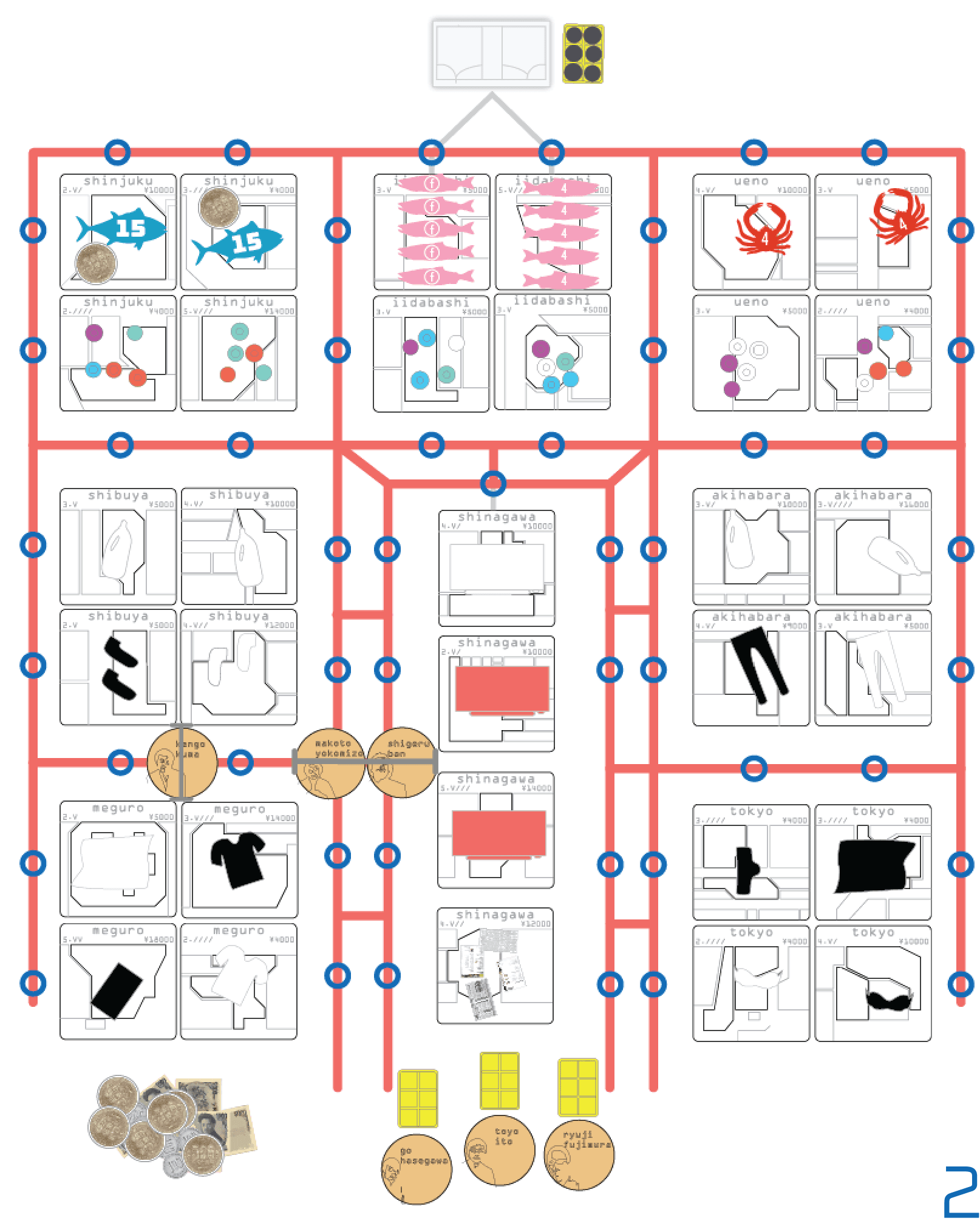
GAMEPLAY: There are two options for playing the game, with dexterity, or without. Decide as a group which version you would like to play. With the dexterity version, you will have to add items to your shopping basket, and once added, you may not touch them anymore and must push your basket using your architect token. If anything falls out, it is discarded as lost. With the strictly economic version, there is no pentaly for items falling out and you may touch everything in your basket as you wish.
The player to last go shopping will go first, then play will follow in clockwise order. On your turn you must move between 1-3 spaces (shown by the blue dots on page 19), and then you may take 1 item from a card you are directly in front of (or use the vending machine if touching it). From a blue dot location, you may move to any other blue dot connected by a line with no other blue dots between as shown on page 19. This is 1 space. You may make a 180 degree U-turn as a movement, but you may not end your turn on the same space you started on.
Begin moving through the shopping center, grabbing as many items as you can manage, and when you are ready, make your way back to the entrance at the bottom of the map. You may only exit out the double lanes in the center. You will exit the store with your lot of goods a total of two times. When you exit, take the items, a mackerel barrel, and a payout for each as shown by the market prices. Place the items in front of you. Then reduce yen on cards you were paid out for by 100 yen only, regardless of the number of items you took in that category. On your next turn, enter the store again at the middle double lanes.
EXAMPLE: You exit the store first with two shirts, a red drink, a salmon, and a crab pulled from the bag. Nice haul. You take 600 yen for the two shirts, removing 100 yen from that card stack. You take 300 yen for the red drink, and take 100 yen from the red card. You place the salmon with the ‘f’ side up in front of you and take 500 yen. You place the ‘6’ crab you pulled from the bag in front of you, and take 600 yen. Your turn is now over and you will enter the store again on your next turn.
While most items have a direct payout price, some are special as follows:
NEWSPAPERS/MAGAZINES: These are used as tie-breakers, and the player with the most will break any end game ties.
DETERGENT: Each detergent you exit the store with will double the value of a single clothing item payout. EXAMPLE: You leave the store with 2 bras, 1 shirt, and 2 detergent. You choose to apply the first detergent to the shirt, incresing the payout from 300 to 600, and the second to a bra, increasing the payout from 300 to 600. You may not apply multiple detergent to a single item.
CRABS: Instead of taking a crab from a card, you instead pull one from the bag randomly.
TUNA: First, you must have 500 yen and pay it to the bank, then pull a random tuna from the bag. Each tuna you purchase after the first will cost +500 yen.
SALMON: Take a salmon from the card, and if you are the first player out of the store, you will get 500 yen per salmon and place them with the ‘f’ side up. If any player (including yourself) has already left the store with any salmon, take 400 yen per salmon and place them with the ‘4’ side up.
VENDING MACHINE: To use the vending machine, you must be at one of the two blue locations shown with grey lines touching the vending machine. Dump the entire crate of black drinks in the vending machine. Take all drinks that come out, and remove any stuck drinks and place them back in the crate next to the machine. If any drinks are paid out, or dropped from carts, add them to the vending machine crate (or next to it if full).
GAME END: When all but one player have 2 mackerel barrels from exiting the store 2 times, the game will end immediately. The player left in the store will not receive any payout for current cart items.
Count up all of your yen, and the player with the most is the winner! If there is a tie, the player with the most magazines/newspapers wins. If there is still a tie, you are all consumers.
BOTTLE BONUS!
- Players
- 2-8
- Time
- 20-30 min
- Games required
- TOKYO JUTAKU & TOKYO JIDOHANBAIKI
BOTTLE BONUS is a variation of TOKYO JUTAKU that uses pieces from JIDOHANBAIKI.
This game plays exactly as TOKYO JUTAKU does. After each round ends, before moving, the player who completed their building from the round will take a number of drinks randomly from the box equal to the number of other players. They will then drop those drinks into the vending machine all at once, and all other players may grab up to 1 drink that comes out of the vending machine.
These drinks now grant a special one-time use power to the players who grabbed them, based on the specific drink color as follows:
BLACK: Spend this drink to flip over your site card before you start building on it. Players cannot look at the back side before deciding to flip or not.
WHITE: Spend this drink and then place 1 piece on your site card before the round begins.
MINT: At any time during the round, spend your mint drink and yell ‘put it back’. All other players must put back the piece they are currently using, or the last one they placed, and take a different piece from the supply.
BLUE: Spend this drink before one round of building. If you win that round, keep this drink next to your site cards for +200 yen (¥) at game end. If you do not win this round, discard this drink.
RED: Spend this drink to move 2 pieces at the same time for this round only. You will still only grab one piece at a time, but you may freely arrange it and one other piece on your building simultaneously.
PURPLE: During the move phase, spend this drink to move to any available site card on the map, ignoring regular movement rules.
CHOCOLATE MILK
- Players
- 2-8
- Time
- 15-25 MIN
- Designer
- JORDAN DRAPER
- Game type
- ECONOMIC MARKET
- Games required
- TOKYO JIDOHANBAIKI (2 copies for 7-8 players) & TOKYO JUTAKU
Chocolate milk utilizes a player-controlled market, along with set collection and selling, to try to profit the most from the vending craze across Tokyo.
SETUP: Take 9 site cards from TOKYO JUTAKU and arrange them into a 3x3 grid. Give each player an architect token. Place all of the drinks on the table (if playing with 7-8, only use drinks from a single copy of the game). Place the 6 colored stock cards in a row, and the 6 shape stock cards in a row below that. Randomly place one drink on all of the outer site cards, and 2 drinks on the center card, along with every player’s architect token. Give each player 500 yen. Place the vending machine at the top of the grid. Give each player a crate, and place any remaining crates next to the vending machine.
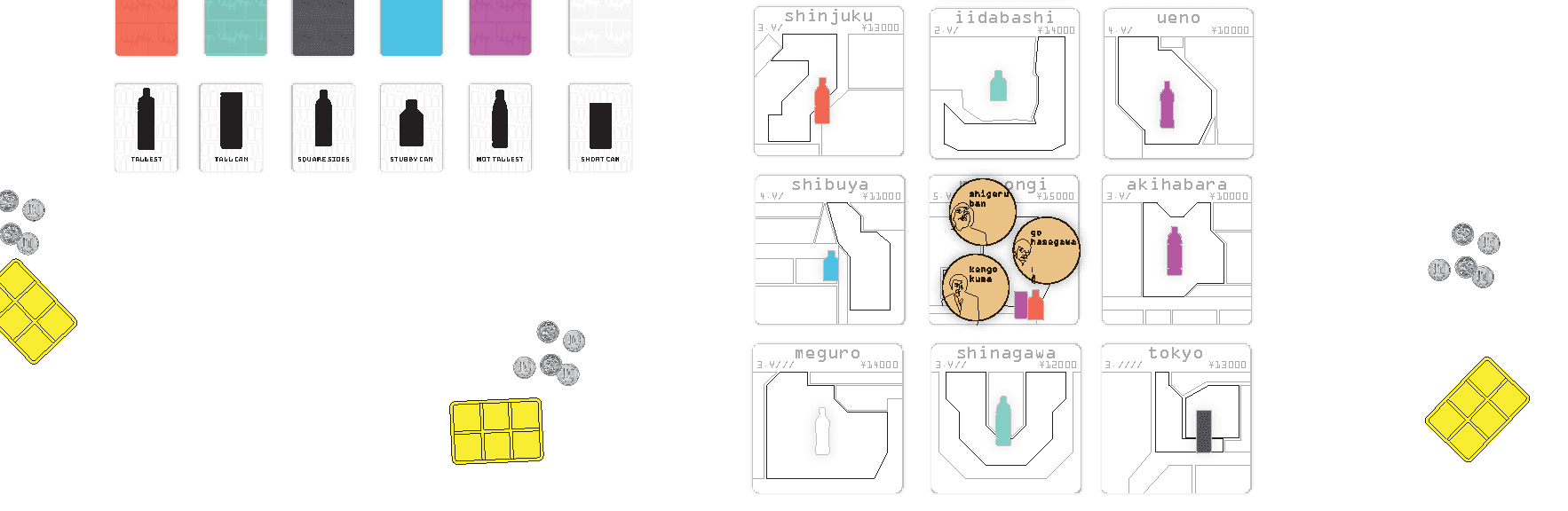
GAMEPLAY: Whoever used a vending machine last is the starting player. On your turn you may do 1 of 3 things:
- Move 1 space away (vertically, horizontally, or diagonally), and purchase a drink for 100 yen. Drop the drink into the vending machine. If it comes out, place it into a crate you own. Then place 100 yen onto the corresponding stock color card, and stock shape card, of the drink you purchased. (For a more strategic game, do not use the vending machine, and immediately receive the drink purchased.)
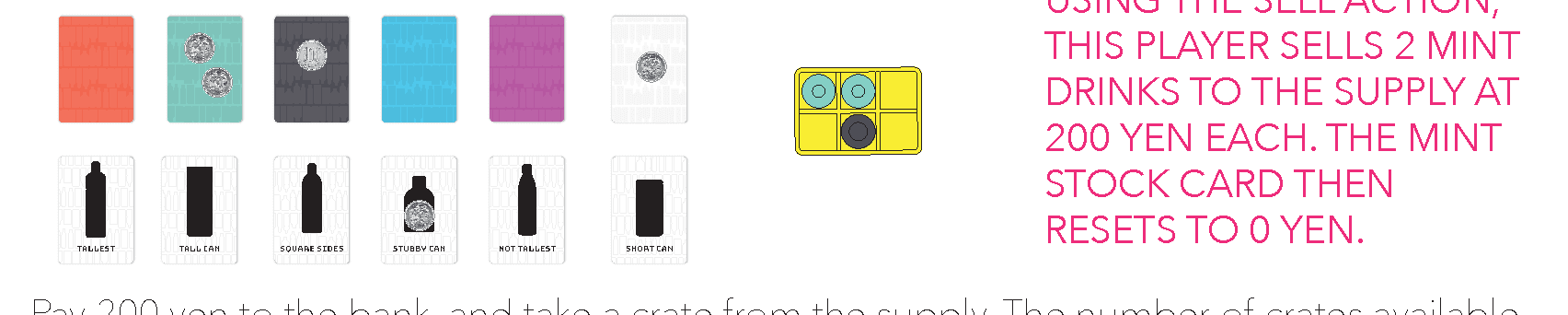
- Sell drinks to the supply. You will receive payment for the drinks based on a single stock card market price (eg blue, tallest, stub, etc.). The price on the card will be paid for each drink you sell that matches the attribute. Return the sold drinks back to the supply, and then return all yen from the stock card back to the bank.
USING THE SELL ACTION, THIS PLAYER SELLS 2 MINT DRINKS TO THE SUPPLY AT 200 YEN EACH. THE MINT STOCK CARD THEN RESETS TO 0 YEN.
- Pay 200 yen to the bank, and take a crate from the supply. The number of crates available for purchase will vary, based on the number of players and copies of JIDOHANBAIKI in use. With an extra crate, it is possible to hold more than 6 drinks, and to score both crates separately for set collection at game end.
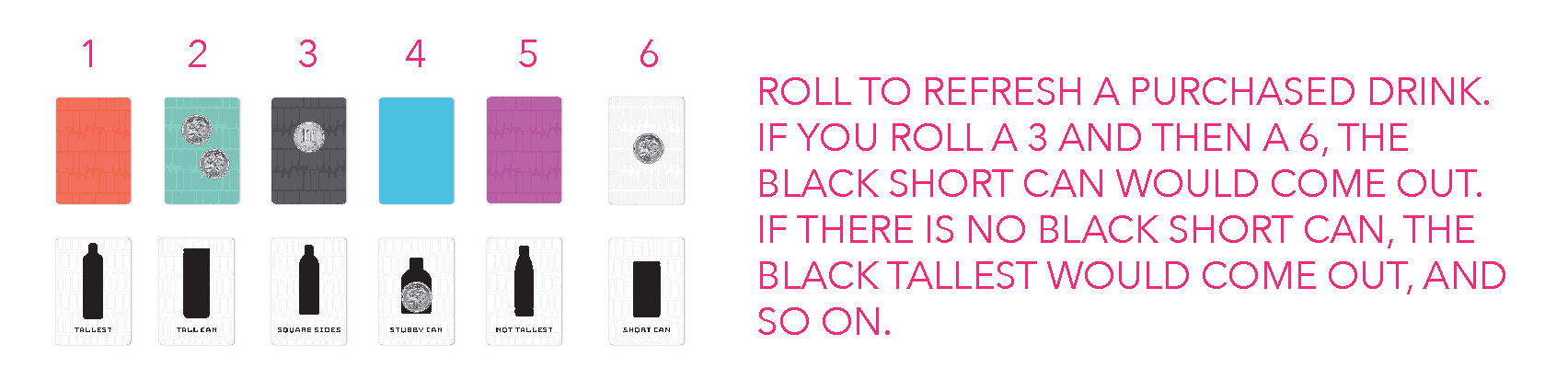
REFRESH: If a player uses the move action, immediately replace their purchased drink with a new one by either randomly pulling a drink from the supply, or if you have a die, roll for the color (using the stock cards as reference starting on the left) and then for shape (using the stock cards again). If a color or shape is no longer in the supply, simply move to the next available option shown on the stock card to the right.
ROLL TO REFRESH A PURCHASED DRINK. IF YOU ROLL A 3 AND THEN A 6, THE BLACK SHORT CAN WOULD COME OUT. IF THERE IS NO BLACK SHORT CAN, THE BLACK TALLEST WOULD COME OUT, AND SO ON.
GAME END: The game ends when any player has 6 of the same type or color of drink in one of their crates, or a player has at least 2,000 yen.
SCORING: Each crate is scored separately, and may only be scored for either a single color or a single drink shape. Each player chooses a single attribute (i.e. the color red or stub cans) and then counts the number of drinks matching that attribute in their crate. Multiply it by itself and receive a payout. For example, 5 mint drinks would be 5x5 = 2,500 yen in payout.
Add your personal yen to the payout you receive from crates, and the player with the most yen is declared the winner!
FAQ
Does the game contain 69 wooden pieces? No: a complete copy contains 68 wooden pieces, so a copy with 68 is not missing anything. Printed rulebooks say 69; that is a misprint the designer has confirmed and apologized for, corrected here.
What are the correct component counts for site cards, wood pieces, and architect tokens? A complete copy has 36 site cards (32 standard plus the 4 bonus advanced Roppongi cards added during the Kickstarter campaign), 68 wooden pieces, and 8 architect tokens. Rules printings listing 32 cards or 69 pieces are out of date: the 69 is a confirmed misprint, corrected by the designer to 68.
Is the game still playable when one of the 68 wood pieces is missing? Yes: the designer says you will be just fine with a single piece missing. The only games that may feel stressed for fairness are 8 player games, since certain sites need the smaller pieces.
How do you play Tokyo Jutaku solo, given the main game is a real-time race? The official solo mode is Countdown, the extra game included in the rulebook for 1 to 8 players; the main game itself has no solo rules.
Must pieces be placed lying flat, and what happens to a site card you fail to complete? Pieces are placed flat: you may flip and rotate them, but not stand them upright. A failed card is never discarded; after a round you may either keep the same site card and try again instead of moving, or return it and move your architect token up to two spaces to a new site. Only successfully completed cards are removed and kept for their yen value.
What happens when a player says 'stop!' without actually fulfilling their card's requirements, and how do you handle doubtful claims? If the requirements were not met, everyone continues building, including the player who called stop, until someone says 'stop!' again; if they were met, that player keeps the site card for its yen value and everyone returns the pieces on their cards to the center. For doubtful claims, the check step allows deconstructing the building: the designer suggests asking the stop caller to take theirs apart to prove the requirements, especially on the hard side of the cards.