Living rulebook
Tokyo Jidohanbaiki
TOKYO JIDOHANBAIKI
TOKYO JIDOHANBAIKI is a game consisting of many smaller games from a conglomerate of international designers. The main gameplay focuses around a vending machine tower, miniature Japanese drinks, crates, and stock cards. Each game is unique and may not utilize all of the included components.
CONTENTS
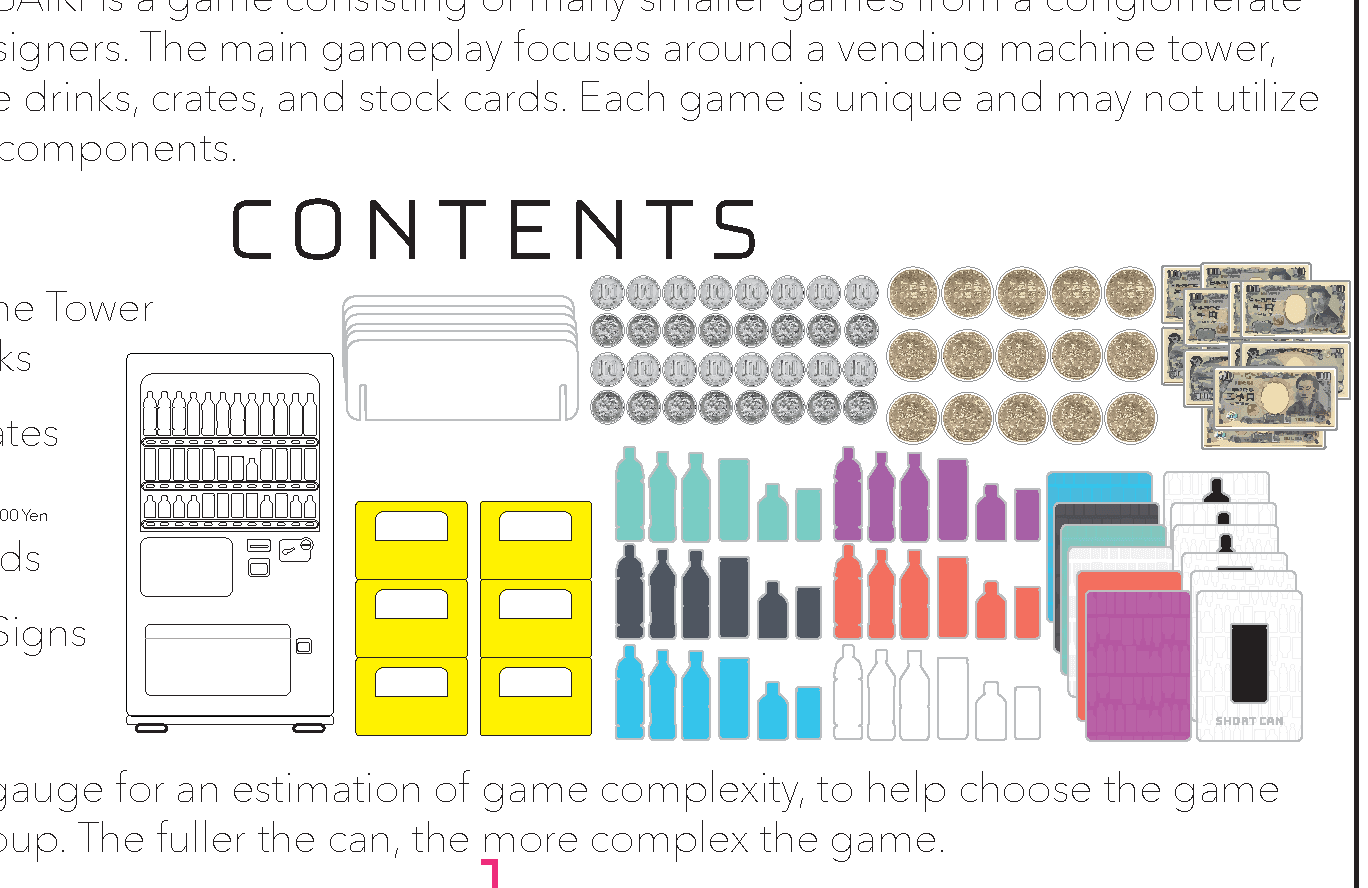
- 1 - Vending Machine Tower
- 36 - Miniature Drinks
6 Colors / 6 Shapes
- 6 - Yellow Drink Crates
- 59 - Die Cut Chits
32 100 Yen / 15 500 Yen / 10 1000 Yen / 2 5000 Yen
- 12 - Mini Stock Cards
6 colors / 6 shapes
- 12 - Advertisement Signs
LEMON SQUASH
- Players
- 2-12
- Time
- 15-25 MIN
- Designer
- NICK HALPER (DARK FLIGHT)
- Game type
- DEXTERITY
The objective in Lemon Squash is to be the first player to knock over each drink in the correct order.
SETUP: Using the 6 yellow crates, prepare a rectangular arena, setting the vending machine at one end. Place a 500 yen piece in the center of the arena. Each player takes a full set of colored drinks, removing the short can, and then randomly places the remainder of the drinks upright anywhere in the arena.
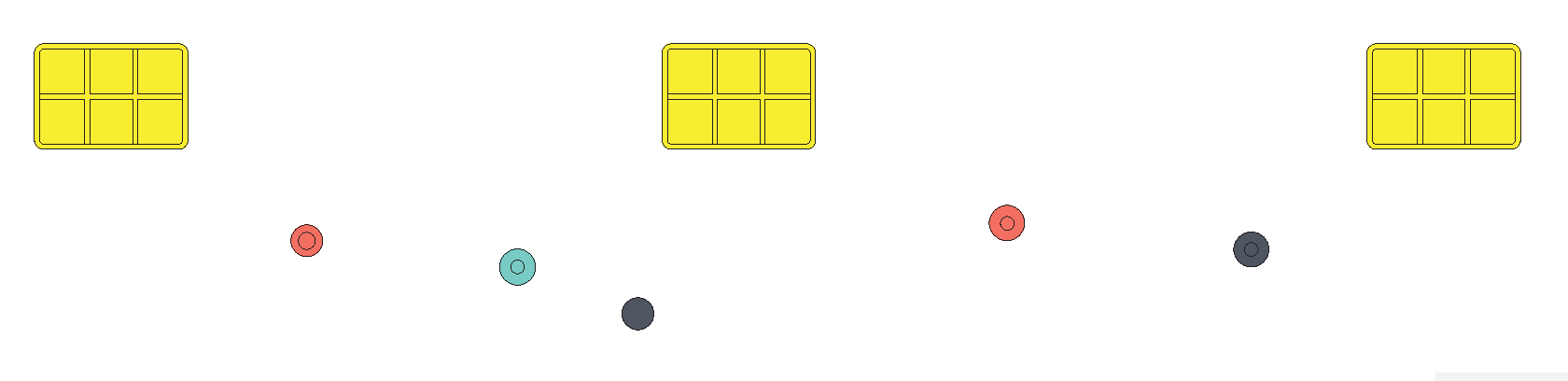
Give each player 500 yen. Drop each player’s short can into the vending machine simultaneously, then determine player order based whose drinks went the farthest from the vending machine. Arrange the color cards in a row in player order. Remove the short can card from the drink stock cards, and then shuffle them. Place them from left to right creating a second row below the player color cards. This displays the order that drinks must be knocked over during the game.
GAMEPLAY: In player order, each player takes turns flicking their short can, attempting to knock down a drink. The very first shot is always taken from the 500 yen coin. If a player successfully knocks over a drink, they take it and place it on their player color stock card.
It is not allowed to to flick using more than one finger; no thumb leverage allowed.
If a player knocks over the incorrect drink, or multiple drinks (including their target drink), they must pay 100 yen to the bank. They do not collect incorrect drinks and must reset them upright in close proximity to where the drinks began. If a player loses all their yen, they must return their collected drinks to the play area, setting them up as before, and take out another 500 yen.
If a player’s drink exits the arena, place it back where it crossed the boundary border. After each turn, the player stands their small can upright where it landed.
GAME END: The first player to knock over all 5 drinks in the correct order (as shown by the drink stock cards) is the winner! Note: color does not matter, only drink type!
If playing with 7 or more, teams will be formed with members taking turns to flick.
CREAMED CORN
- Players
- 2-7
- Time
- 1-5 MIN
- Designer
- KERSTIN S (QUALITY BEAST), NICK H, & JORDAN D (DF)
- Game type
- DEXTERITY/1 VS ALL
Race to complete your task first!
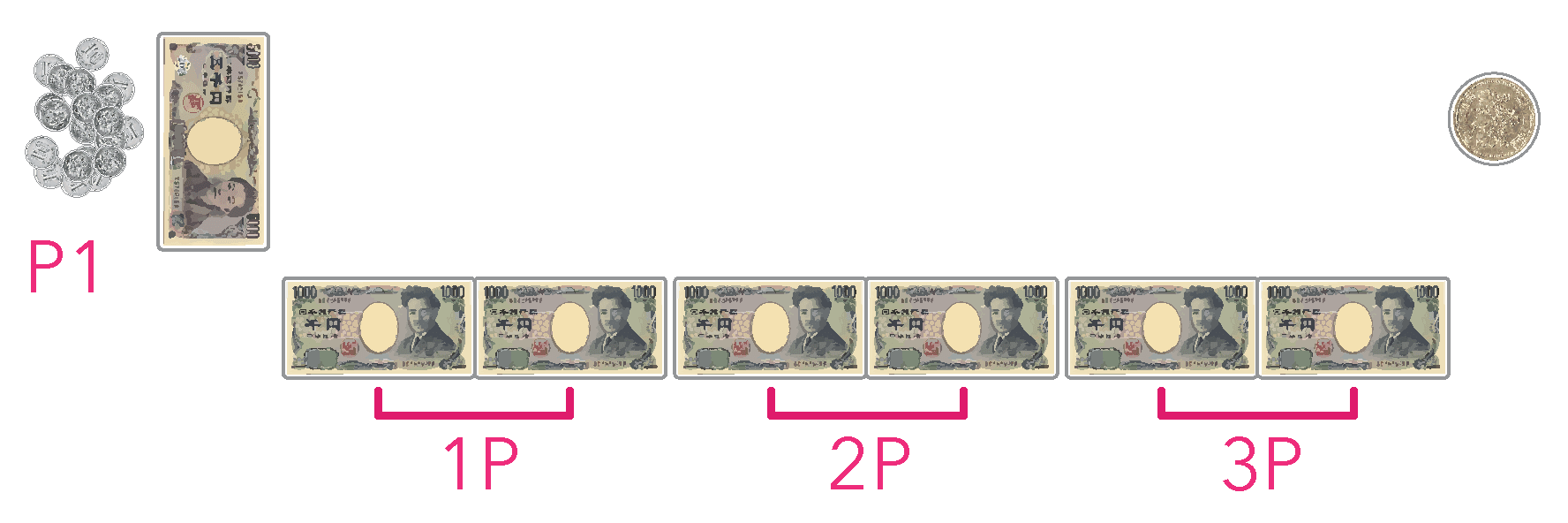
SETUP: Put all drinks in a pile. Place a 5,000 yen bill as the starting line. Then, place a 500 yen coin at a distance of two 1,000 yen bills per player. Place all 100 yen coins in a pile behind the 5,000 yen bill. Select one player as the magical golden ball racer, and give all other players a yellow drink crate.
GAMEPLAY: The magical golden ball racer races to make a solid connecting trail of 100 yen coins, from the starting line to the 500 yen piece, picking up only one coin at a time and using only one hand.
All other players race to fill their crate with 1 drink of each type and color, picking up only one drink at a time and placing it in their crate. No player may have a repeat of any drink type or drink color, and must end up with 6 drinks in their crate.
The first player to complete their challenge is the winner!
With 5-7 players, split the crates and players into two separate teams that will communicate and compete against the ball racer. Only one player’s crate needs to be complete for an entire team to claim victory for that team.

GENMAICHA
- Players
- 2-6
- Time
- 15-20 MIN
- Designer
- DYLAN HOWARD CROMWELL
- Game type
- ECONOMIC, CRAFTING
Genmaicha is a combination of green tea and roasted brown rice. In this game players will compete to brew the best blends of this “people’s tea”!
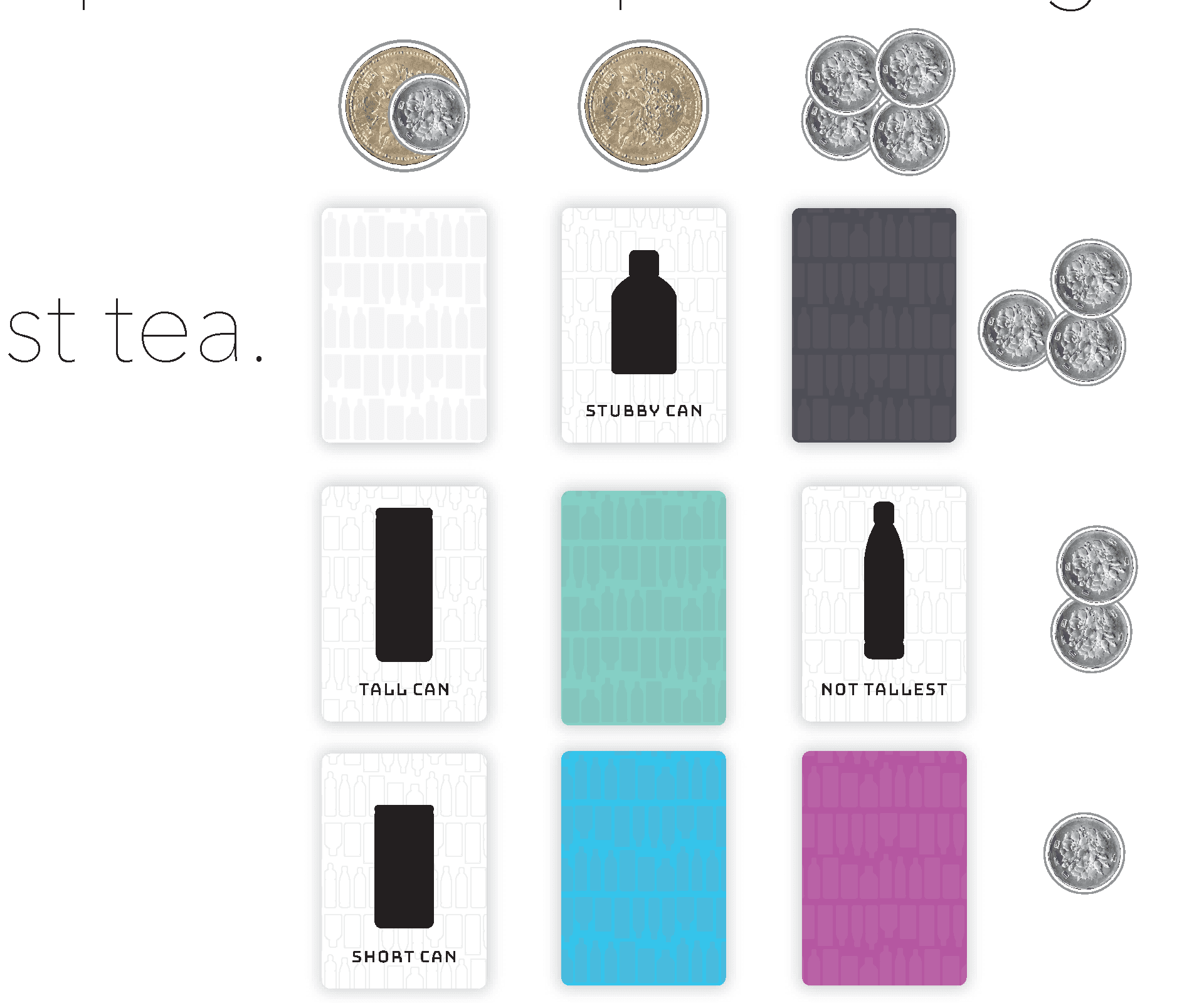
SETUP: Shuffle all the stock cards and randomly lay out 9 face up in a 3x3 grid. Discard the rest of the cards. Place 100 yen next to the bottom row, 200 next to the middle, and 300 next to the top. Then place 400 yen next to the leftmost column, 500 next to the middle, and 600 next to the right. Put the drinks into an opaque container (like a bag or the box) . Give everyone 500 yen. Place empty crates equal to the number of players next to the grid. The last person to sip tea will go first.
OBJECTIVE: To have the most yen at the end by brewing the best tea.
GAMEPLAY: In Genmaicha the grid of cards is a map of recipes, three horizontal and three vertical. The colors and shapes of the drinks are all considered various ingredients. Each drink recipe is a combination of three ingredients, forming a column or row.
ROUNDS: The game takes place over 3 rounds (or 4 in a 2-player game). Each round includes a bidding phase, and then a brewing phase.
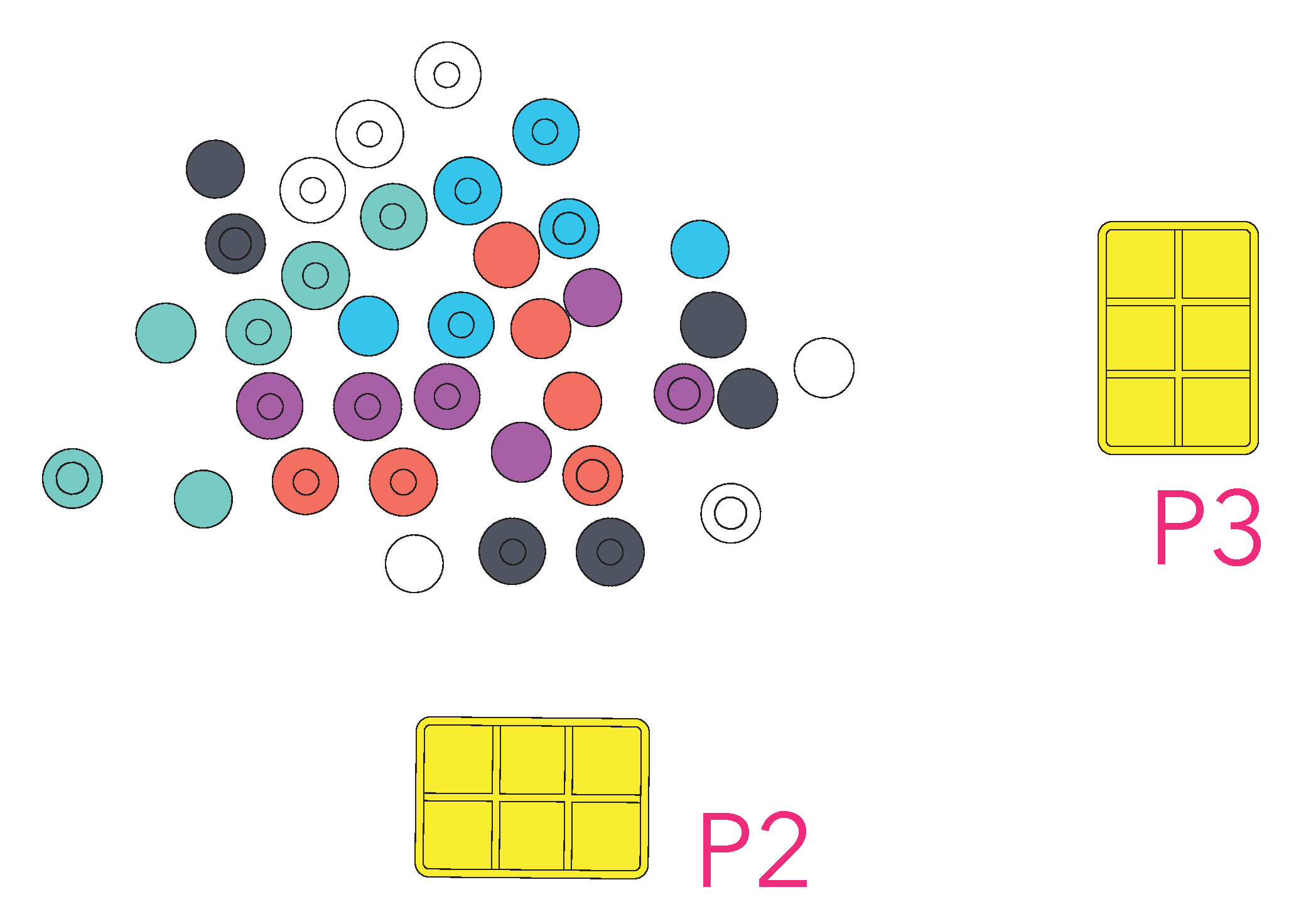
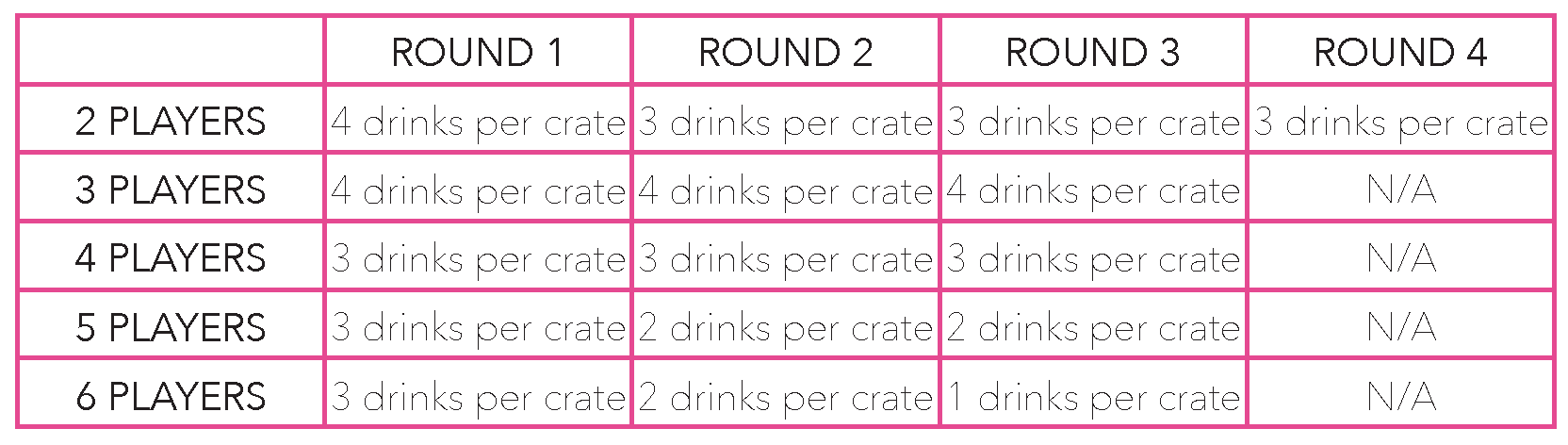
BIDDING ROUND: Each Bidding round, randomly fill the empty crates with drinks from the bag (or box) based on the chart below:
Players prepare a blind bid by putting any amount of yen from their stash into their hand. All players reveal at the same time. Any ties are resolved with a follow-up, accumulative bid. Further ties are solved by coin toss. Players will now select a single crate in order, starting with the highest bidder moving down. Take all drinks from the crate chosen.
BREWING ROUND: In the order determined in the bidding round, players may use any of their drinks to fulfil as many tea recipes they can. Each drink can be used as two ingredients (shape or color), even in separate drinks. Drinks may not be used for the same condition twice. For example, a blue stub can may be used as a blue ingredient, and a stub can ingredient, but not two blue or two stub can ingredients. Players successfully create a recipe by fulfilling the ingredients of a row or column of three cards, discarding the drinks used back to the supply. The player receives the total amount of yen placed next to the recipe line from the bank, and then reduces the amount of yen there by 100 yen (to a minimum of 0). Any used drinks are discarded back to the bag or box.
GAME END: After the last round, the player with the most yen is the winner. If there is a tie, the player with the most drinks left is the winner. If still a tie, the players high five and share the win.
VARIANTS: The following variants can be played separately, or mixed together for one big Matcha-iri Market Ceremony, if you like.
MATCHA-IRI: In this variant, players try to add matcha to their recipes. During setup, place 100 yen between each card on the left column, and 200 yen between each card in the middle and right columns. Players may brew a row and add one extra ingredient from a column that is directly above or below the recipe. If they successfully add the extra ingredient, they take the amount yen placed between the cards as a bonus.
TEA CEREMONY: Players try to add a special ingredient to please an honored guest. During setup, place the 3 remaining cards face down above the top row. During the brewing phase, players may discard an ingredient that matches one of these cards to take a peak at one of them. During brewing, they may attempt to brew a 4 card recipe, including a face down top row card. If they are successful they receive an extra 500 yen, and flip the card face up. If they are not, they discard all drinks used and receive their regular recipe yen, leaving the card face down.
TEA MARKET: In this variant, players are branding their recipes. If you are the first to brew a recipe you may choose to brand that recipe by placing an ad next to it. Rotate the ad so it is facing you. Place at least 100 yen on it. Later, when someone crafts that recipe, you are paid out the amount you placed, and also receive your yen back. Discard the ad.
GRAPE SODA
- Players
- 5 drinks collected.
- Time
- 15-30 MIN
- Designer
- JORDAN DRAPER
- Game type
- MODULAR AREA CONTROL
Grape Soda is a game about utilizing a modular grid to take advantage of your opponents’ short-sightedness!
SETUP: Place the 6 crates together in a square to make a 6x6 grid. Give each player a full color set of drinks. The player who last drank grape soda goes first.
GAMEPLAY: On your turn, you must move a single crate, and place or move a drink.
MOVING A CRATE: You may move any crate before or after you place or move a drink. You must move one crate. Crates may not be rotated, nor break the contiguous body of crates.

EXAMPLE
PLACING OR MOVING: To place a new drink, take one drink from your supply and place it into any grid spot, as long as it is not adjacent to a drink of a different color (horizontally, vertically, or diagonally). Optionally, you may move a drink instead of placing a new one. You may move the drink only one space away, either horizontally, vertically, or diagonally. If possible, you may jump over a drink/drinks of another color and collect them for points, as long as you have a space to land in on the other side of the drinks and you do not jump a drink of your own color in the process.
GAME END: As soon as a player has collected the winning number of drinks, the game ends and they are declared the winner! The winning number of drinks is determined by player count:
CHOCOLATE MILK
- Players
- 2-8
- Time
- 15-25 MIN
- Designer
- JORDAN DRAPER
- Game type
- ECONOMIC MARKET
- Games required
- TOKYO JIDOHANBAIKI (2 copies required for 7-8 players) & TOKYO JUTAKU
Chocolate milk utilizes a player-controlled market, along with set collection and selling, to try to profit the most from the vending craze across Tokyo.
SETUP: Take 9 site cards from TOKYO JUTAKU and arrange them into a 3x3 grid. Give each player an architect token. Place all of the drinks on the table (if playing with 7-8, only use drinks from a single copy of the game). Place the 6 colored stock cards in a row, and the 6 shape stock cards in a row below that. Randomly place one drink on all of the outer site cards, and 2 drinks on the center card, along with every player’s architect token. Give each player 500 yen. Place the vending machine at the top of the grid. Give each player a crate, and place any remaining crates next to the vending machine. Whoever used a vending machine last is the starting player.
GAMEPLAY:
On your turn you may do 1 of 3 things:
- Move 1 space away (vertically, horizontally, or diagonally), and purchase a drink for 100 yen. Drop the drink into the vending machine. If it comes out, place it into a crate you own. Then place 100 yen onto the corresponding stock color card, and stock shape card, of the drink you purchased. (For a more strategic game, do not use the vending machine, and immediately receive the drink purchased.)
- Sell drinks to the supply. You will receive payment for the drinks based on a single stock card market price (eg blue, tallest, stub, etc.). The price on the card will be paid for each drink you sell that matches the attribute. Return the sold drinks back to the supply, and then return all yen from the stock card back to the bank.
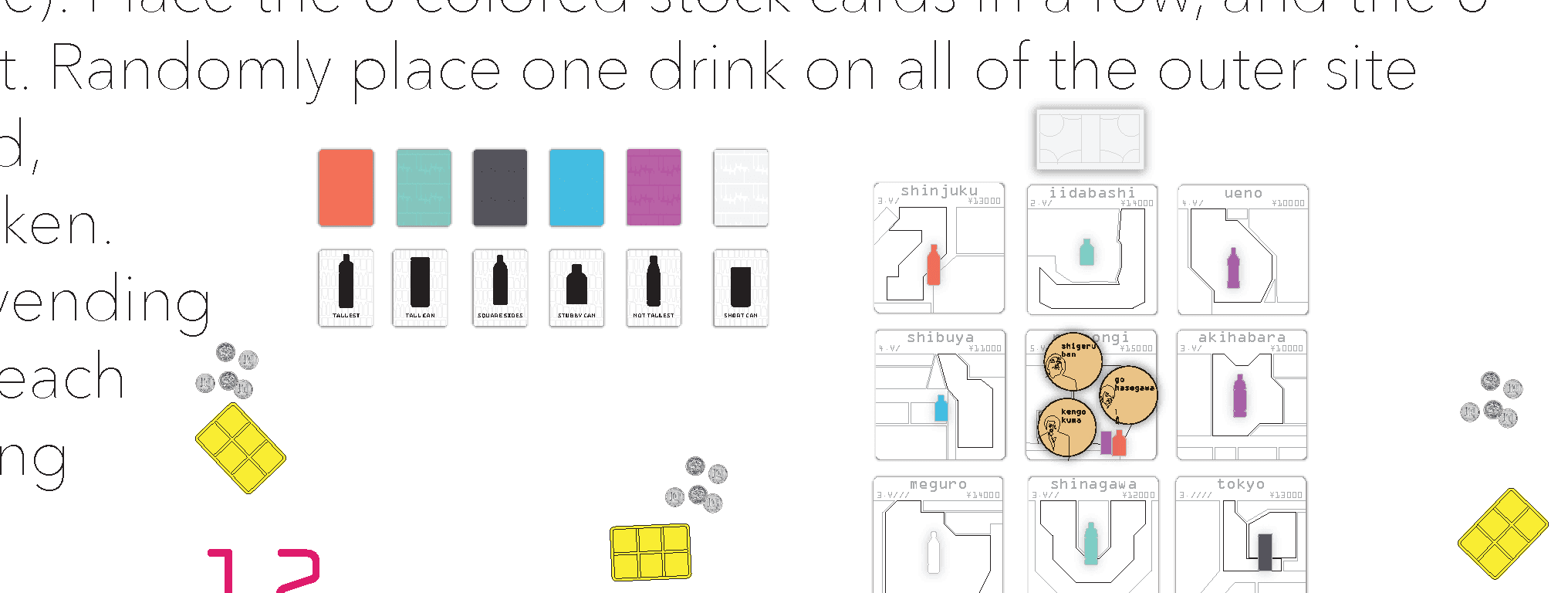
EXAMPLE:
USING THE SELL ACTION, THIS PLAYER SELLS 2 MINT DRINKS TO THE SUPPLY AT 200 YEN EACH. THE MINT STOCK CARD THEN RESETS TO 0 YEN.
- Pay 200 yen to the bank, and take a crate from the supply. The number of crates available for purchase will vary, based on the number of players and copies of JIDOHANBAIKI in use. With an extra crate, it is possible to hold more than 6 drinks, and to score both crates separately for set collection at game end.
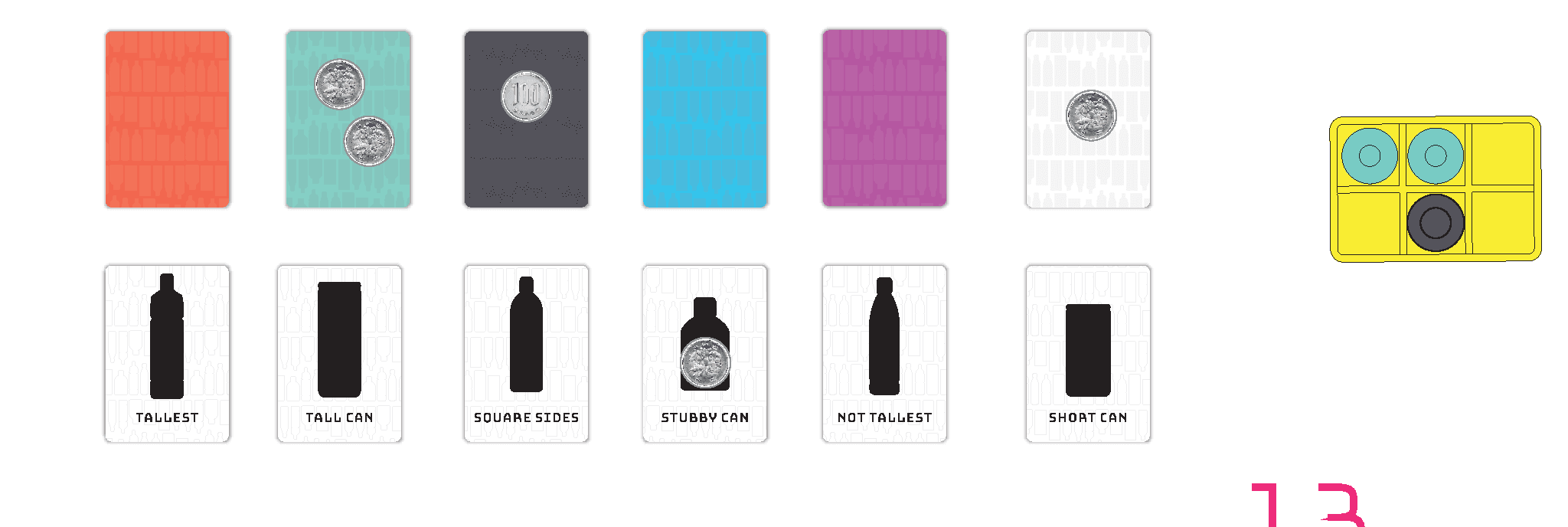
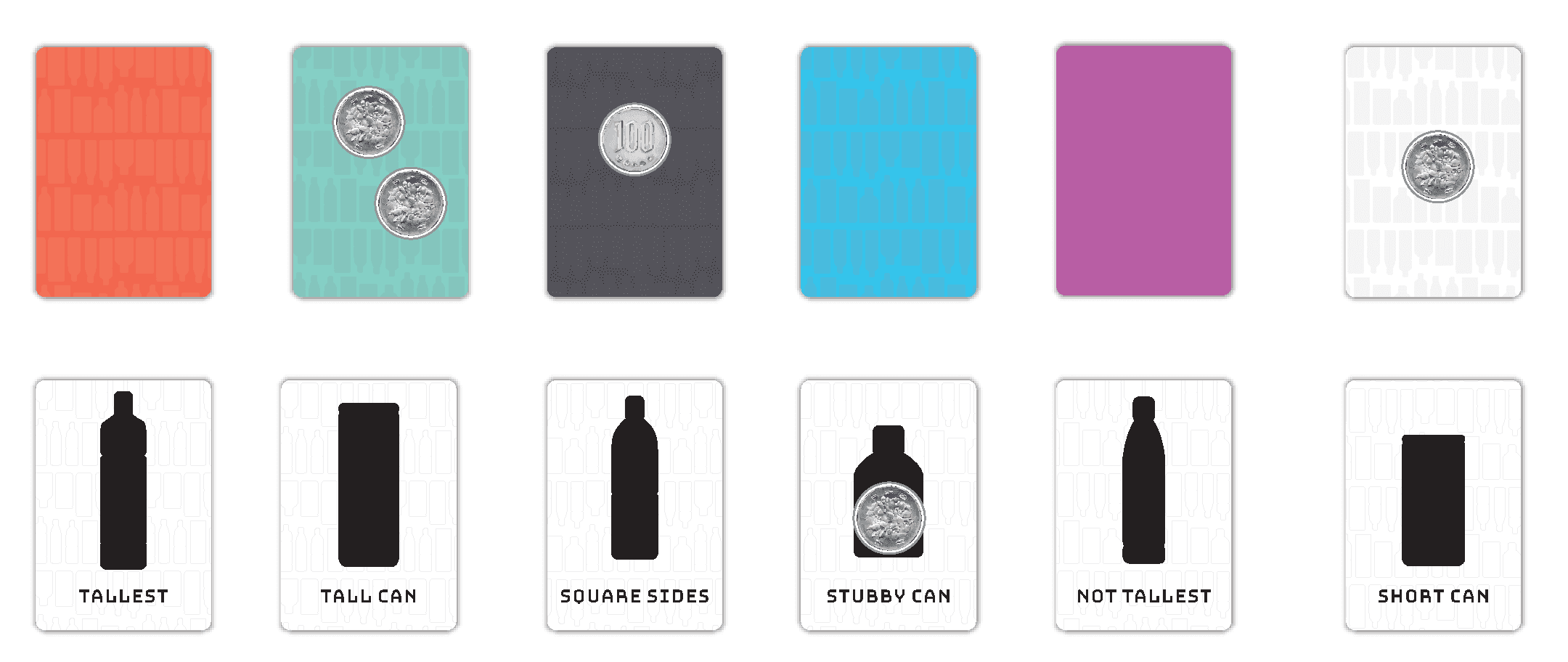
REFRESH: If a player uses the move action, immediately replace their purchased drink with a new one by either randomly pulling a drink from the supply, or if you have a die, roll for the color (using the stock cards as reference starting on the left) and then for shape (using the stock cards again). If a color or shape is no longer in the supply, simply move to the next available option shown on the stock card to the right.
EXAMPLE:
ROLL TO REFRESH A PURCHASED DRINK. IF YOU ROLL A 3 AND THEN A 6, THE BLACK SHORT CAN WOULD COME OUT. IF THERE IS NO BLACK SHORT CAN, THE BLACK TALLEST WOULD COME OUT, AND SO ON.
GAME END: The game ends when: any player has 6 of the same type or color of drink in one of their crates, or a player has at least 2,000 yen.
SCORING: Each crate is scored separately, and may only be scored for either a single color or a single drink shape. Each player chooses a single attribute (i.e. the color red or stub cans) and then counts the number of drinks matching that attribute in their crate. Multiply it by itself and receive a payout.For example, 5 mint drinks would be 5x5 = 2,500 yen in payout.
Add your personal yen to the payout you receive from crates, and the player with the most yen is declared the winner!
PURA
- Players
- 1
- Time
- 15-1500 MIN
- Designer
- JORDAN DRAPER
- Game type
- SOLITAIRE, SORTING
In Pura you play as a recycling sorter, looking to make sense of the many bottles and cans that have been turned in for recycling.
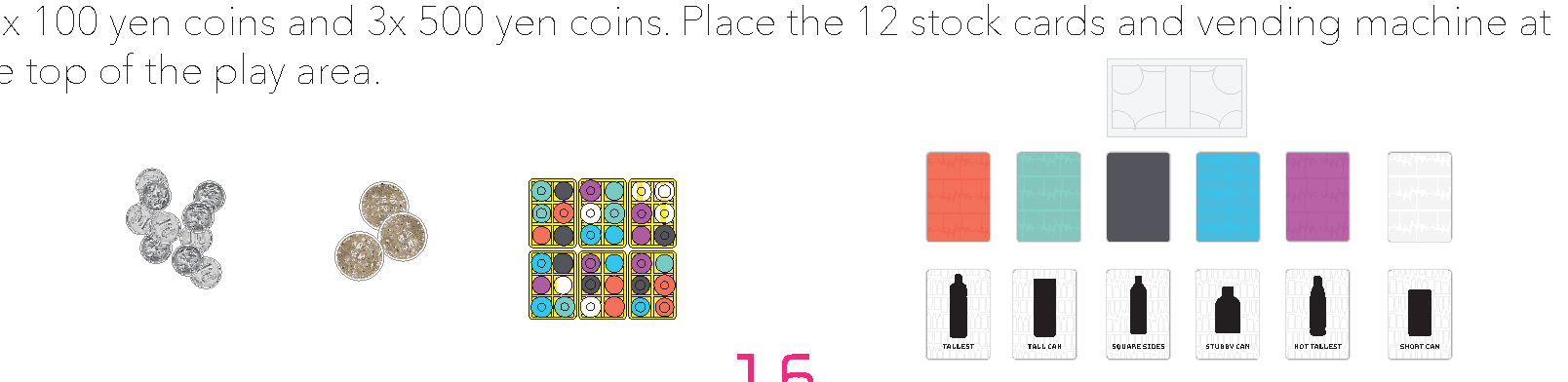
SETUP: Place the six crates in a 3x3 grid, randomly pull out drinks one by one from the box lid and fill the crates with all 36 drinks. If any crates have more than 3 of a single shared element in them (color or shape), you must swap one of the drinks causing this condition with another drink in a neighboring crate. Once these conditions are met, make a pile of 10x 100 yen coins and 3x 500 yen coins. Place the 12 stock cards and vending machine at the top of the play area.
OBJECTIVE: To get all 36 of the drinks onto the stock cards without running out of money, or having any drinks stuck in the vending machine.
GAME RULES: You may freely rearrange the crates however you like, as often as you like, including rotating crates.
100 YEN COIN: Spend a 100 yen coin to do one of the following:
- Remove all the drinks that match a single stock card condition from a single crate. For example, remove all of the blue drinks, or remove all of the tall cans, from a single crate. Place the removed drinks on the stock card chosen. If you manage to remove 6 drinks at once, take 300 yen from the spent supply pool of 100 yen coins.
- Swap any or all drinks from a single side of a crate with a single side of another crate that is directly adjacent to it. This means up to 2 drinks could be swapped on the short side of the crate, and 3 on the long side.
EXAMPLE: IT IS POSSIBLE TO SWAP UP TO 4 DRINKS ON A SHORT SIDE, OR 6 DRINKS ON A LONG SIDE. ALL SWAPS ARE STRAIGHT ACROSS, AND THE QUANTITY SWAPPED IS OPTIONAL
500 YEN COIN: Spend a 500 yen coin to take an entire crate of drinks, and drop them into the vending machine simultaneously. Place all drinks that come out onto a matching stock card. If a drink gets stuck, it may be possible to spend another 500 yen coin to drop in more drinks and knock it out. If any drinks are stuck in the vending machine after spending your last 500 yen coin, you lose the game. Thus, it is best to save your 500 yen coins if possible
GAME END: If you manage to sort all 36 drinks onto the stock cards, you win! Add up all yen you did not spend, and this is your end score. If you ran out of yen without sorting all of the drinks, or if any drinks are stuck in the vending machine and thus not sorted, you lose the game. Please try again.
If you are a master of recycling sorting, try starting the game with only 8x 100 yen coins and 2x 500 yen coins.

PURA PURA
- Players
- 1
- Time
- 5-10 MIN
- Designer
- TRAVIS D. HILL
- Game type
- SOLITAIRE, SORTING, PUZZLE
Someone mixed up all of the drinks and it’s up to you to get them sorted into their correct crates before time runs out!
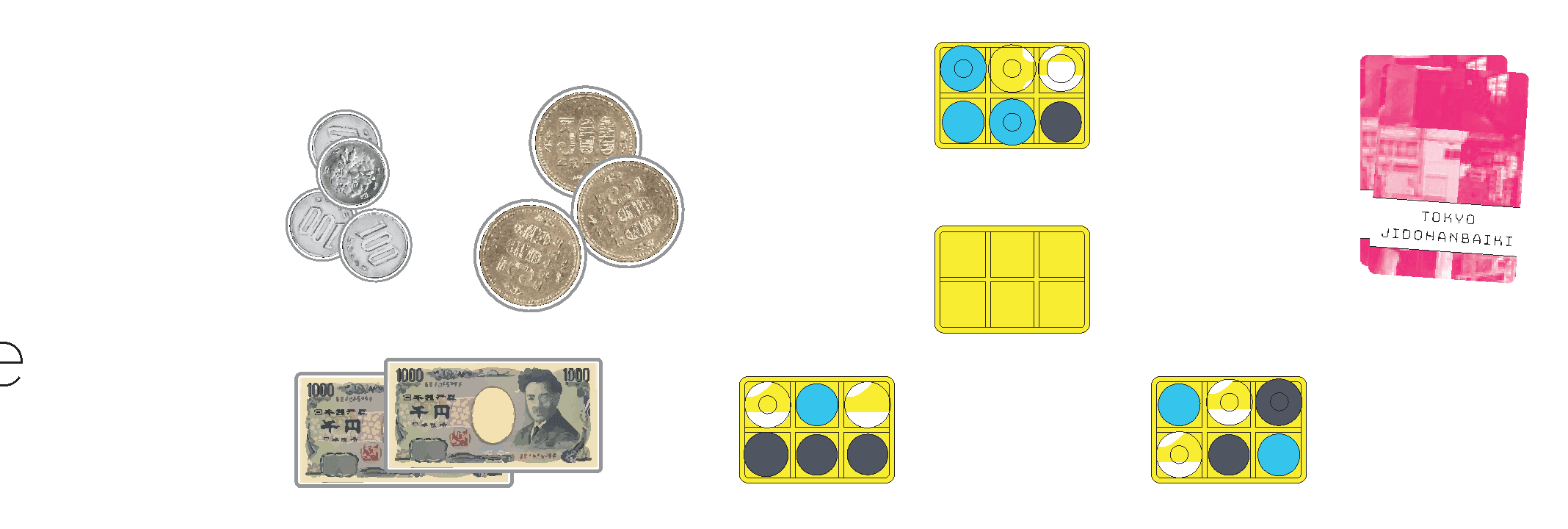
SETUP: Place 3 crates in a triangle in front of you, and place a 4th crate in the center of it. Make separate stacks of 4x 100 yen, 3x 500 yen, and 2x 1,000 yen pieces. Take the 12 stock cards and randomly return any 3 color cards (and the matching drink pieces) to the box. Shuffle the remaining 9 cards into a face-down draw pile. Take all of the remaining drinks (6 each in 3 different colors) and randomly place them into the 3 outside crates. If you want to use the vending machine to randomize, do that! Make sure there no more than 3 drinks of a single condition per crate. If there are, swap drinks between crates until resolved.
GAMEPLAY: Flip the top card of the draw pile; the card will tell you what shape or color of drink you must move. Move that drink to an open space in any other crate. When moving, the drink must stay in the same position from its current crate to its new crate.
Example: You draw the stub can card. You take the green stub can from the top left of its current crate and place it in the top left spot of its new crate. The drink can be moved between any of the 4 crates.
Continue until you can draw no more cards. This signifies the end of the round. Discard one of the 100 yen pieces and shuffle the deck, forming a new draw pile.
SPECIAL ACTIONS: Any time before, during, or after you move a drink, you may spend yen to perform a special action.
- •Discard a 500 yen piece to move a drink to an empty adjacent space in the crate. Cannot be moved diagonally.
- •Discard a 1,000 yen piece to swap the positions of 2 drinks in the same crate.
- •Once you run out of yen, you may not take that special action.
GETTING PAID: If you draw a card where all of the matching pieces are in their correct crate, set the card aside. At the end of the round, before reshuffling, you may “spend” each card to return discarded yen you used for special actions. Each card counts as 500 yen. You may not spend it to return 100 yen pieces. You may set aside multiple cards this way and return multiple denominations of yen.
Example: You draw a yellow card and all of your yellow drinks are in the same outside crate; you set aside the card. At the end of the round, you use that card to return a discarded 500 yen piece to its original stack of yen. Then, you shuffle the card back into the draw pile.
GAME END: When the final 100 yen piece is discarded, the game is over and you lose.
To win, separate the 3 colors so that the 3 outside crates contain only 1 color of drink before discarding the last 100 yen piece. Once each crate is completed, the game ends immediately. Count the yen you have not discarded, including set aside cards, and that is your score. You begin with 3,900 yen, so the closer you get to that total, the better you did!
VARIANTS:
- •Too hard? Add a 100 yen piece to give you an extra round; the other rules remain the same.
- •Too easy? Add a 100 yen piece to give you an extra round, but all drink shapes must match the exact space in their crates (your choice) with all other drink shapes in other crates.
Example: All Tallest must be in the top left, stub cans in the bottom right, etc...
- •Too chaotic? Instead of winning by filling the outside crates, you win by having like-colored drinks in any 3 of the 4 crates.
- •Too simple? Add an additional crate (or two) and another color (or two) to the mix. For each crate/color added, add 100 yen to the time stack.
YUZU TWIST
- Players
- 1-6
- Time
- 10-20 MIN
- Designer
- STEFAN BRAKMAN
- Game type
- AREA CONTROL, PUZZLE
SETUP: Each player picks one or more colors, depending on the amount of players. Then, each player takes the matching stock card and places it in front of them.
2 player: 3 colors / 3 player: 2 colors / 4-6 player: 1 color each; any extras remain unused.
- 4-6 player game is played in teams in some combination of 2v2, 3v2, or 3v3. When played in teams, only one member of the team needs to win for the entire team to win.
Sort the drinks by shape and place all six drinks of one type in one crate. Then, place the crates in a square grid of 3x3.
OBJECTIVE: To fill one crate with the six drinks of your color. Whoever does this first wins the game.
GAMEPLAY: The game is played in turns. The starting player is the one who ate yuzu most recently. Each turn a player must first move one of the crates, and then makes two swaps.
Moving Crates: You may move any crate and rotate it as you like with some restrictions:
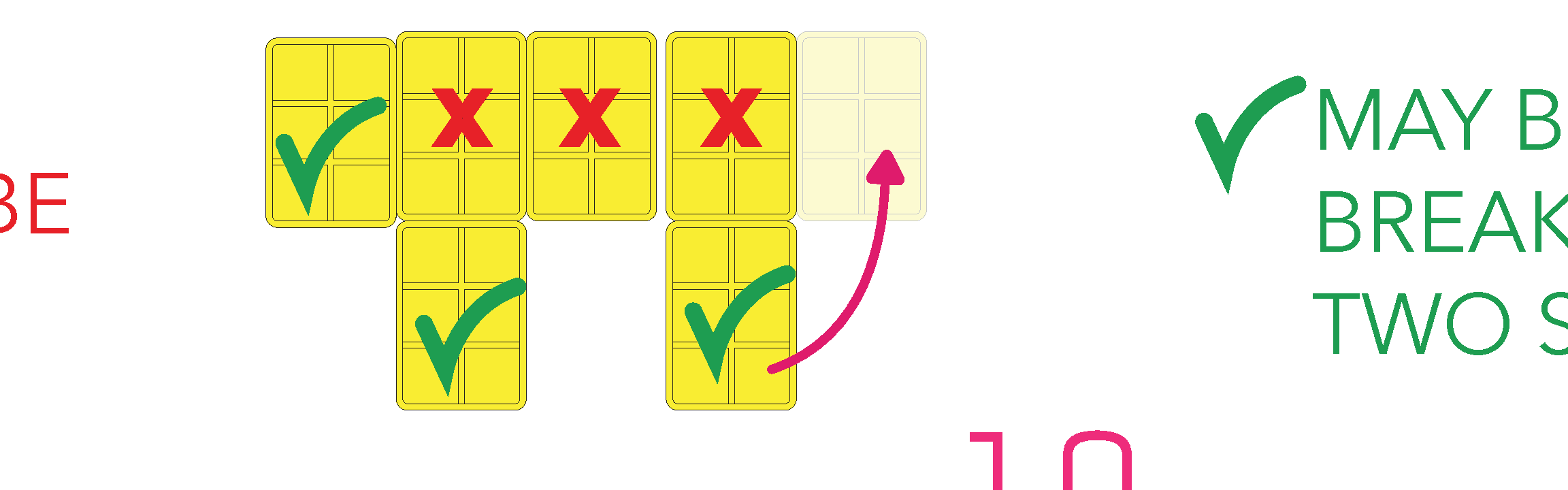
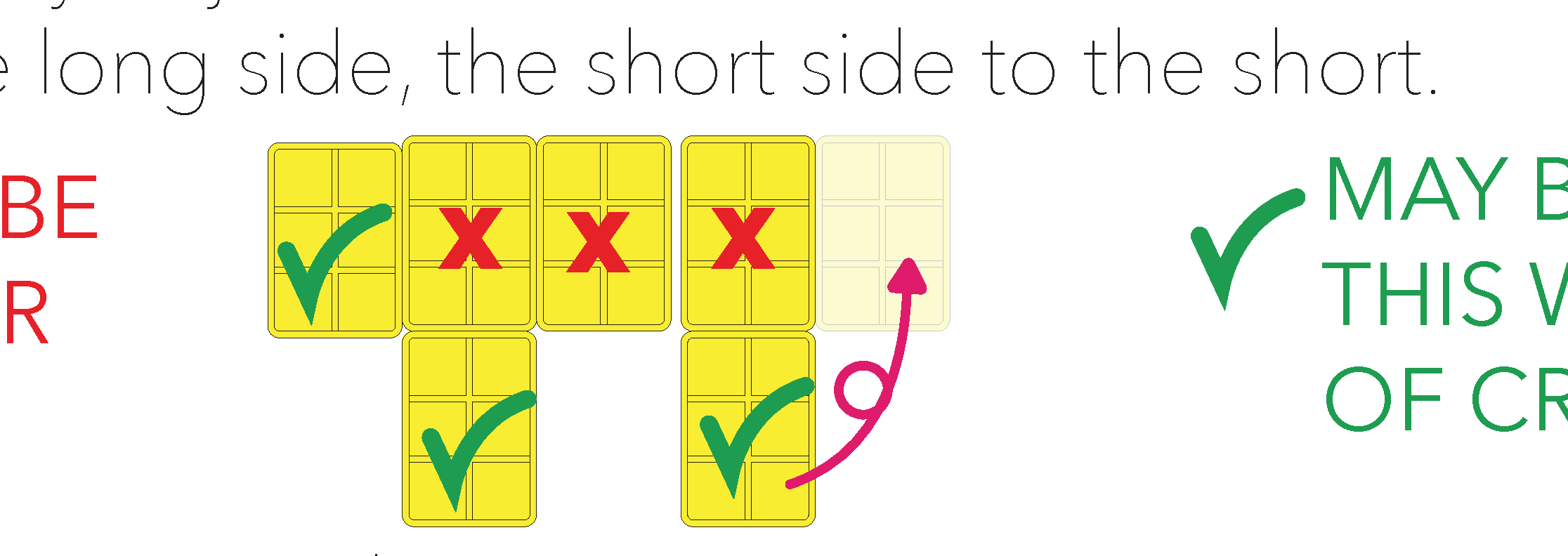
Crates may not break the contiguous group of crates, splitting the group of crates in two. You may not rotate a crate if it cannot be moved. Crates can only be moved to a space vertically or horizontally adjacent to another crate, and the sides must match: the long side has to connect to the long side, the short side to the short.
EXAMPLE: MAY NOT BE MOVED OR ROTATED
MAY BE MOVED OR ROTATED AS THIS WILL NOT BREAK THE BODY OF CRATES INTO TWO SECTIONS
Swapping drinks: You may make two swaps on your turn. You may swap any two drinks vertically, horizontally, or diagonally. You may swap all colors and types of drinks. This might cause drinks to change crates. It is also allowed to swap the same drink on consecutive turns.
GAME END: Whenever there is a crate with five drinks of the same color, the player with that color wins the game.
BLIND VERSION: In this version the player's color is hidden. Instead of picking the cards, you draw them blind, and keep them face down in front of you.
SOLO VERSION: In a solo version you try to get all the drinks sorted by color and track the amount of turns it takes to do so. Keep a tracklist so you know how well you did.
KAMIKAZE CANS
- Players
- 2-6
- Time
- 15-20 MIN
- Designer
- STEFAN BRAKMAN
- Game type
- ABSTRACT, AREA CONTROL
SETUP: Place all 6 crates in a square to make a 6x6 grid. Each player picks one color of drinks and places them in front of them as their stock.
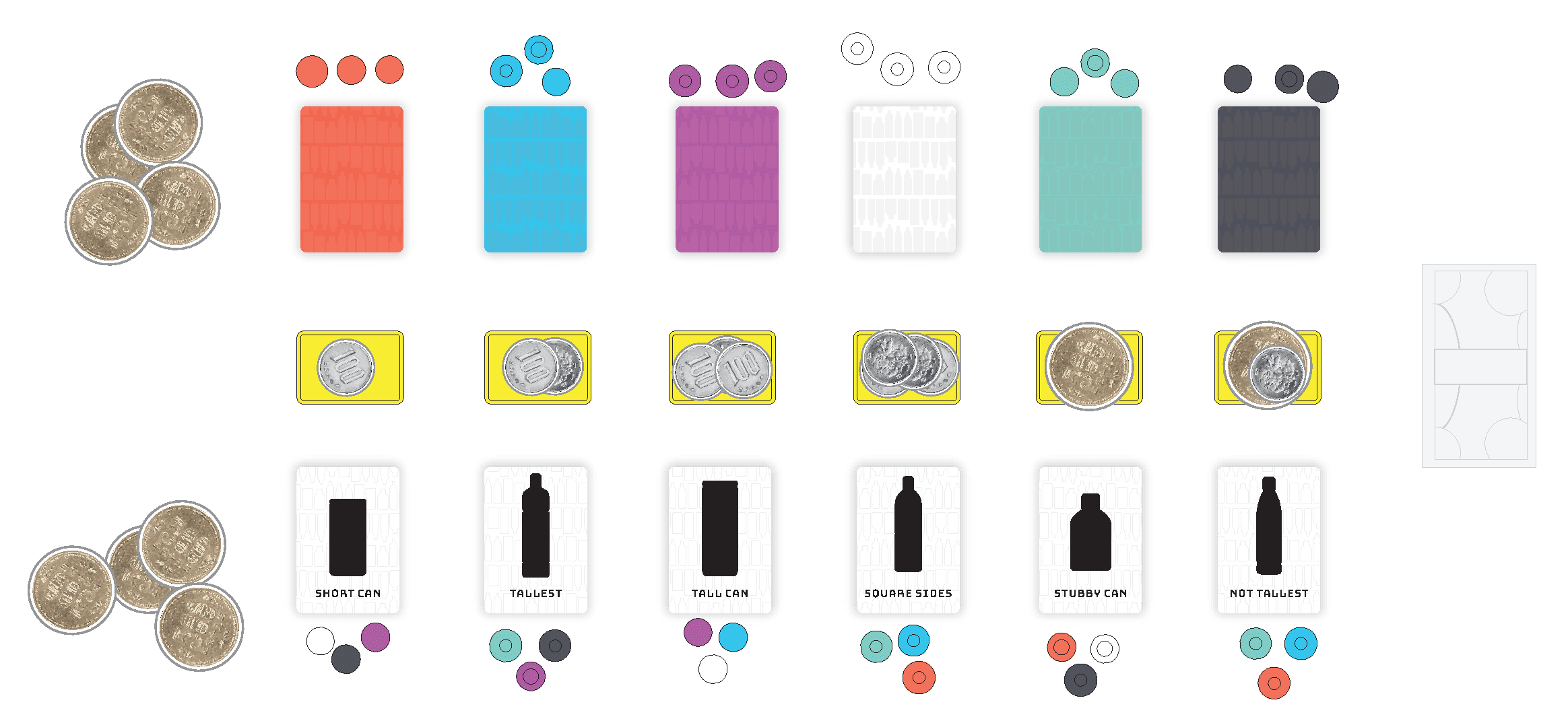
Place the six drink type cards in this order:
stub can: place 4 coins above this card
short can: place 1 coin below this card
tall can: place 2 coins below this card
square sides: place 3 coins above this card
not tallest bottle: place 2 coins above this card
tallest bottle: place 1 coin above this card
OBJECTIVE: The goal of the game is to place drinks in the grid to score points. However, cans can explode and destroy bottles. The player who has most points at the end of the game wins.
GAMEPLAY: The game is played in turns. Each turn you choose 1 of the following actions:
- Place a drink from your stock in the grid
- Move one of your drinks
- Explode one of your cans
Placing drinks: You place any drink from your stock in an empty space on the grid.
Move one of your drinks: A drink can move in a horizontal or vertical line as many steps as you want, as long as it stops in an empty space. However, it cannot jump over drinks of the same shape or taller. The length of the drinks is indicated by the order of the cards. The stub can is the shortest and cannot jump over any drinks. The tallest bottle is the tallest and can jump over any drink except another tallest bottle. You can jump over multiple bottles, as long as they are shorter.
Explode one of your cans: Instead of placing a drink or moving a drink, you can choose to explode either your small can or your tall can. Both explosions destroy the area around the can, thereby removing all drinks adjacent in any direction (vertical, horizontal, diagonal) from the game.
If this causes another can to be destroyed, that can also explodes before being removed, possibly causing a chain reaction.
GAME END AND SCORING: The game ends when one player places their last drink on the grid. Then each player scores points for their drinks in stock and their drinks in the grid.
The points are indicated by the coins above or below the drink cards.
Points for the drinks in stock are scored as positive points for the coins below the card, and as negative points for the coins above the cards.
Example: The stub can in stock is -4 points; the tallest can is +2 points.
Points for the drinks in the grid are scored for positive points above and negative below.
Example: A tallest bottle in the grid is scored +1 point; a small can in grid is scored -1.
VANCOUVER SWEAT
- Players
- 2-6
- Time
- 5-10 MIN
- Designer
- STEFAN BRAKMAN
- Game type
- MATCHING, TAKE THAT
SETUP: Each player picks one or more colors, depending on player count, and takes the matching stock card(s).
2 player: 3 colors
3 player: 2 colors
- 4-6 player: 1 color each; any extras remain neutral
Randomly place all the drinks in a 6x6 square, with roughly 1 inch in between all drinks. Designate one edge of the grid as the bottom and place an empty crate.
OBJECTIVE: The goal of the game is to collect bottles by picking them from the square. Picking bottles will give you points, but be careful... some are worth negative points:
All the bottles and stub of your own color are 1 point
All the bottles and stub of another color are 0 points, but can cancel minus points.
The small can is minus 1 point - requires one bottle or stub can to be cancelled out.
The tall can is minus 2 point - requires two bottles or stub cans to be cancelled out.
GAMEPLAY: The game is played in turns. Each turn a player first chooses three connecting drinks (either horizontal or vertically). Out of the three drinks you choose, two of them must match the color of another player. You cannot choose three drinks of which a neutral color has the majority.
From those three drinks, you choose any two of them and give them to the player who had the color majority. You do not have to pick the two drinks of the same color. These drinks can be positive points or negative points, depending on the drinks taken.
Then shift all the drinks towards the crate first and then left, until there are no "gaps" in the square. Play passes to the player on the left.
GAME END AND SCORING: If there are no more drinks to pick, or no player is allowed to pick any more drinks, the game ends. Each player now counts the amount of points. The player with the most points wins the game!
5 CAN STUB
- Players
- 2-6
- Time
- 15-30 MIN
- Designer
- JAKE AND ZACH GIVEN (LAY WASTE GAMES)
- Game type
- DRINK POKER, PUSH YOUR LUCK
You and your friends have stumbled upon a pile of money and a vending machine! Rather than do any number of responsible things, you decide to compete for the riches using the only method you know: Vending Machine Poker. Gamble your way to the top!
SETUP: Each player starts off with 1 crate and the following currency: 1x 1000 Yen bill, 2x 500 Yen coins, and 3x 100 Yen coins. Place the vending machine with your favorite ad in the center of the table. Place all 36 of the various cans in a pile within reach of all players. Line up the Stub Can, Short Can, and Tall Can stock cards, and then place a 100 yen coin above the set. Do the same for the set of Square Sides, Not Tallest, Tallest stock cards, but place 200 yen coins above the set. Choose starting player at random and the game begins!
OBJECTIVE: The goal is to be the last person remaining in the game.
GAMEPLAY: On your turn, you must either 'Buy a can' or 'Pitch a can'. If you can do neither, you are out of the game.
Buying a Can: Stub Cans, Short Cans and Tall Cans cost 100 each. Square Sides, Not Tallest and Tallest cost 200 each. You may buy up to as many cans as your crate has available spaces. You may choose from any of the cans in the pile (that are not in the vending machine). Money used to purchase cans is placed in the center, creating the pot. You may never “make change” with the pot, but you may overspend to take a can. Then, take each of the cans you purchased and place them into the vending machine one at a time. You must place all purchased cans in the vending machine. Any cans that come out are yours to add to your crate. If more cans come out than your crate can hold, you may replace cans in your crate and discard any extras.
Pitching a Can: Rather than buying a can, you may choose to take any number of cans from your crate and put them into the vending machine. Any cans that come out are yours! Unlike buying cans, you may choose to pitch more cans after the first can if you like.
Placing in the Vending Machine: You may drop your cans into the vending machine from any height or angle. If you touch the vending machine directly or knock it over while trying to place a can in, you are immediately out of the game. If any of your cans bounce out or otherwise miss the vending machine, they are forfeit and returned to the pile of cans. Cans that are more than halfway out of the bottom of the vending machine count as being fully out and are be retrieved by that player. If any additional cans come out when removing cans in this way, return them to the pile of cans.
CALLING: At the end of your turn, you may ‘call’. You must take a turn before calling. You may call with any number of cans in your crate, even if you have less than 5 cans. If you have 6 cans in your crate at the end of a round, you automatically call. All other players take one more turn.
After all players have finished, choose any 5 of the cans in your crate to score your hand. Using classic poker ranks, the best hand wins.
Important changes noted here:
-Rather than suits, there are 6 different colors. Flushes can be created by having 5 cans of the same color.
-Refer to the order of the can cards for hierarchy increasing in value from left to right (Stub Cans are the least valuable, Tallest the most valuable).
-5 cans of a kind is the best hand
The player that wins the round must empty their basket back into the pile. If they have 6 cans, they may keep the can that was not part of their winning hand. The winner takes all the money from the pot and adds it to their own stash. All other players keep the cans in their basket for the next round.
If winning hands are tied, split the pot. If the pot cannot be split evenly, distribute as much of the pot as possible evenly amongst the winners and leave the leftover money in the pot for the next round. Tied players must empty their baskets.
ENDING THE ROUND: Empty any remaining cans in the vending machine back into the pile. The player to the left of the player that called the previous round starts the next round.
GAME END: The game is over when only one player remains. Players are eliminated if they are unable to purchase a can and are unable to pitch a can, or if they touch the vending machine or knock it over when placing cans in it.

CRATE WARS
- Players
- 2
- Time
- 20-30 MIN
- Designer
- JORDAN DRAPER
- Game type
- STRATEGY
SETUP: Place the 6 crates upside down in a line between the two players. Place 100 yen on the 1st crate, 200 on the 2nd, 300 on the 3rd, and so on down the line ending at 600. Randomly place the 6 color cards face up on one player’s side of the crates, and the 6 shape cards face up on the other player’s side, aligning both cards on either side with one crate each. Give each player 3 drinks that match each of their stock cards, 18 drinks in total, keeping them in front of the player. These form their supply. Each player takes 4x 500 yen coins. Place the vending machine at one end of the row of crates.
OBJECTIVE: To win crate matchups in order to have the most cumulative yen at game end.
The player on the side with the color cards is the color player, while the player on the side with the shapes is the shape player. For each player, each drink matching the card type adjacent to the crate is worth the yen amount on the crate. For example, if the purple stock card is in front of the 300 yen crate, then all purple drinks on the color player’s side count as 3 points toward scoring. If the stub can stock card is in front of the 500 yen crate, all stub cans are worth 5 points toward scoring for the shape player.
GAME PLAY: On your turn, you perform one of three actions:
1.Place a single drink from your supply on a stock card adjacent to a single crate on your side of the crate line.
2.Spend a 500 yen coin to drop all of the placed drinks from a single stock card on your opponent’s side into the vending machine. Return any that come out to the card they came from; discard any that do not.
3.Spend a 500 yen coin to return all of the placed drinks from a single stock card on your side to your supply.
PASSING: At any point on your turn, instead of taking an action, you may choose to pass. After passing, you cannot take any more actions, and must discard all remaining drinks in your supply. The other player may then continue taking actions until they also choose to pass.
GAME END: After both players have passed, points are calculated for each crate one by one:
Compare the type of drink (color or shape) with the total amount of matching drinks on that player’s side. And then multiply that number by the crate’s value.
Example: The purple card is in front of the 300 yen crate. Each purple drink played on the color player side is worth 3 points. The color player has 2 purple drinks on their side, so they receive points equal to the number of drinks times the value (2 drinks x 3 = 6 points).
The player with the most points wins that crate. Turn over the crate and place all drinks committed there from both players’ inside. If there are more than 6 drinks, the winning player chooses which extras to discard. If both players tie in score, all drinks committed from both sides are discarded. The winner places the won crate with the drinks inside on top of the stock card on their side. (Add)
SCORING: After all crates have been claimed, go through all 12 stock cards, giving payouts from the bank equal to their yen value The player with the most of that drink condition is paid. For example, if the blue stock is worth 600 yen, the player with the most blue drinks collected is paid 600 yen from the bank. If both players tie for a payout, neither will be paid.
Add up your total yen (including any 500 yen coins that were not spent from the beginning of the game), and the player with the most yen is the winner!
MELON SODA
- Players
- 2-6
- Time
- 10-15 MIN
- Designer
- JORDAN DRAPER
- Game type
- GIVE OR TAKE, SABOTAGE
You are lost in Akihabara! Stumbling past the outfits and arcades, you manage to find your prized gem. The Melon Soda.
SETUP: Each player takes 1 yellow crate, 6 drinks - 1 of each color - and 1,000 yen. Place your starting drinks to the left of your crate, forming your supply. Place the vending machine tower so the front faces all players. Randomly select a starting player and the game begins!
OBJECTIVE: To have the most yen at the end of the game.
GAMEPLAY: On your turn you may perform one of two actions: 1) Add a drink from your supply or 100 yen to the center, which starts the pot or 2) Take the entire pot from the center and then start a new pot by adding a drink from your supply or 100 yen.
PASSING PLAY: After you have performed one of the two actions on your turn, play will pass to the player on your left, and continue this way until a game end condition is met, after which scoring will begin.
TAKE THE POT: If you choose to take the pot, keep all of the yen, and then drop all of the drinks from the pot into the vending machine at the same time. Whatever drinks come out of the vending machine place in your crate. If your crate is already full, you must keep the drinks that come out of the vending machine, and place them to the right of your crate. These may never be used for the remainder of the game. Then, add either a drink or 100 yen to the pot.
*Note that you are not allowed to take yen from the pot unless you put a drink in the pot afterward. If you do not have an available drink in your supply, you cannot take from the pot.
GAME END: The game ends immediately when one of three conditions are met: 1) When all but 1 player has filled their crate with 6 drinks 2) A player has run out of yen and drinks from their supply 3) Only 1 player has drinks left in their supply.
SCORING: You will now score all drinks from your crate. Drinks to the left or the right of your crate will not be scored, and are worth -100 yen each.
Count up the number of unique drink shapes and colors, and then multiply that number by the number of players. Multiply this total by 100 yen, and take this amount from the bank.
Each slot in your crate that was not filled is -100 yen to your score, and each extra drink that is not in your crate is -100 yen to your score. This includes unused drinks from your starting supply. Add up your total yen (including any yen left from your starting amount), and the player with the most is declared the winner!
1-2-3-SODA
- Players
- 3
- Time
- 10-15 MIN
- Designer
- MICHAEL FOX
- Game type
- ECONOMIC, BETTING
Aka: POCARI BET - A quick economic game for three players.
SETUP: Place the vending machine in reach of all players. Give each player 1,000 Yen. Separate the stock cards by shape and color, and shuffle the two sets of cards separately. Place them near the middle of the play area. Place the drinks near the vending machine. Randomly choose one player to receive a crate. This player is the start player. Return the remaining crates to the box.
OBJECTIVE: The player with the most money after 9 rounds wins, or if a player has 10,000 they immediately win!
GAMEPLAY: The game is played in a series of steps, beginning with the start player and continuing clockwise:
1. Each player draws a single card from the top of one of the two decks. Secretly look at it, and then place it face down in front of you.
2.Flip the top card from both of the decks. Find the drink that matches both shape and color, and set it aside.
3.Each person chooses one drink from the remaining available drinks. Once the third player chooses a drink, they choose their second drink and selection continues counter-clockwise until all players have two drinks.
4.Each player declares an amount of money they will invest this round. You must invest between 100-300 yen. Move the money you are investing in front of you so it is clear how much you have stated.
5.Each player states what drink type they are investing in - either a specific color or shape. Example: “I am investing in Blue Drinks” or “I am investing in Short Cans”.
6.The start player collects all seven drinks, including the drink set aside at the beginning of the round, and drops them into the vending machine.
7.Any drinks that fall out will determine how investments pay out. Players now reveal their secret cards. You will receive your initial investment plus the same amount again for each drink of your chosen shape or color that the machine dispenses. If you chose to invest in the shape or color shown on your secret card and it pays out, you receive a bonus 500 Yen.
*If no drinks of your chosen color or type are dispensed by the machine, you lose your investment and gain no money.
*If the Seventh Soda for this turn (as selected by the game) falls out of the machine, the start player loses their entire investment, regardless of what else is dispensed. Note: they also do not receive any bonus!
8.At the end of the round, pass the crate to the player on the left. They are the start player for the next round. Any drinks that fell out of the vending machine are returned to the supply.
*If a player runs out of money at any time, they restart the next round with 500 Yen.
GAME END: At the end of the ninth round, whoever has the most money is declared the winner; or, if a player reaches 10,000 yen at any time, they are immediately declared the winner.
*Remember, some drinks will stay in the vending machine between rounds, so remembering what is in there could mean big payouts! Players may look inside the machine at any time, but may NEVER touch it. Any drinks that are dispensed at any time other than when more are added will be returned to the machine on the next round.
Endless nonsense: Jordan Draper
Rulebook editing: Travis D. Hill
UNLAWFUL DUMPING
- Players
- 3-6
- Time
- 30 MIN
- Designer
- HOJO TORYO
- Game type
- TAKE THAT, DEDUCTION
SETUP: Randomly choose a start player. Depending on player count, each player receives a different number of drinks. Beginning with the start player and continuing clockwise, give each player a number of drinks based on the chart below. Return any extra drinks to the box.
- 3 players: 8 bottles (start player), 10 bottles, 12 bottles
- 4 players: 7 bottles (start player), 8 bottles, 9 bottles, 10 bottles
- 5 players: 5 bottles (start player), 6 bottles, 7 bottles, 8 bottles, 9 bottles
- 6 players: 3 bottles (start player), 4 bottles, 5 bottles, 6 bottles, 7 bottles, 8 bottles
Each player then receives the following yen:
- 3 players: 1,500 JPY
- 4 players: 1,000 JPY
- 5 players: 700 JPY
- 6 players: 500 JPY
Shuffle together all stock cards. Randomly deal two to each player. The player chooses one, keeping it face down, and discards the other. The discarded cards and remaining unused cards are then shuffled and placed as a draw pile. Players then take turns in clockwise order, starting from the player with the least number of bottles.
GAMEPLAY: On the active player’s turn, all non-active players choose and give one drink from in front of them to the active player. For 3 players, they will give two bottles instead. Then, the active player reveals their card, and counts the bottles given to them that match the card. The active player pays 100 yen per matched bottle to the bank. The active player then discards their card, and draws a new one. Play continues to the left. *If the draw pile runs out, shuffle the discard pile to make a new one.
GAME END: When one player has no yen remaining, the game ends immediately.
The winner is the player with the most money. If there is a tie, the winner is the player with the least bottles.
BIRD HEAD
- Players
- 2-4
- Time
- 10-20 MIN
- Designer
- KENICHI TANABE
- Game type
- DEDUCTION, TACTICS
In Japan, we say "Toriatama (Bird-Head)". It means that the bird forgets everything after 3 steps.
SETUP: Give each player 1 crate, and place any remaining back in the box. Place all drinks in the center of the table. Lay out all stock cards face up in the center of the table. They are used as reference only. The start player is the player who most recently listened to a bird call.
GAMEPLAY: During the game, drinks will follow a specific path for movement. Drinks move from the center of the table to a player’s right hand, then to a player’s left hand, and then to the player’s crate. Beginning with the start player and moving clockwise, players take one drink from the center into their right hand and announce its shape and color. If another player has a drink in either hand that shares a color or shape with the newly chosen drink, they may state “I have a ____” drink, revealing their hand. If the drink matches the newly chosen drink as stated, the player who just took the drink
must place it back into the center. In addition, the player who spoke up gets to move the drink from their revealed hand to the next position (from their right hand to their left hand, or from their left hand to their crate). If the player who spoke up was not correct, they must return their revealed hand of drink(s) to the center instead. After play has passed around a single time, players move all drinks in their hand to the next position on the beginning of their turn, before picking a new drink. For example, they would pass from their right hand to left, and/or from their left hand to their crate. Players may not look at the drinks in their fists at any point. If a player is caught looking at their drinks, they must return them.
GAME END: As soon as 1 player has filled all 6 slots in their crate, the game ends. Players place all drinks from their fists into their crate, starting with their left fist. If you end with more drinks than fit into your crate, any extras that do not fit must be placed back into the center.
SCORING: Players score a point for each unique color and each unique shape they have in their crate.
The winner is the player with the most points! If tied, it is the player with the most drinks. If still tied, players share victory!
BATTLE SHIPMENT
- Players
- 2-4
- Time
- 10-15 MIN
- Designer
- KOTA NAKAYAMA
- Game type
- HIDDEN INFORMATION, TACTICS
SETUP: Randomly give each player three cards, returning any remaining cards to the box. Players will now draft 1 card at a time, choosing 1 card and placing it face down in front them, then passing all remaining cards to the player on their left. This will continue until all cards are chosen.
Place all of the drinks in the center, and all of the crates in a line in the center. Place the yen in a separate pile to be used for end game scoring. The player who most recently bought a drink from a vending machine will start, continuing in clockwise order.
OBJECTIVE: To be paid the most yen at game end, based on your secret cards.
GAMEPLAY: On their turn, a player takes one drink, and adds it to a crate in the center line. After a crate has 6 drinks in it, no more may be added, and it is considered the first full crate and placed aside. Place full crates in a line, in the order they are filled.
After the second full crate, all players must place one of their secret cards from their hand face down in front of them. After the fourth full crate, players must place another of their secret cards from their hand face down in front of them.
GAME END: As soon as the fifth crate is full, the game ends immediately.
SCORING: Players score points based on the first card placed in front of them, the second card they placed in front of them, and the crates filled in a certain order as follows:
1st card placed: 200 yen for each matching drink in the 2nd and 3rd full crates. 2nd card placed: 300 yen for each matching drink in the 4th and 5th full crates.
The player with the most yen is declared the winner! If there is a tie, the player who had the most matching drinks in the 1st full crate between both cards is the winner. If there is a tie, players will share victory.
LOST BOTTLE
- Players
- 2
- Time
- 10-15 MIN
- Designer
- KOTA NAKAYAMA
- Game type
- DEDUCTION, TACTICS
SETUP: Place all drinks in the center. Shuffle all of the shape cards together, and randomly place one of them face down at the edge of the table in between both players. Then do the same for the color cards. These cards are now called “hidden cards”. Shuffle all of the remaining color and shape cards together, and randomly give 5 cards to each player. The players take one card and discard it face down in front of them, keeping the remaining 4 in their hand. Whoever used a vending machine most recently will start.
OBJECTIVE: To guess both of the hidden cards correctly first.
GAMEPLAY: The active player will choose one drink, and the opponent must now answer “yes” or “no”, depending on if it matches a condition of the cards in their hand. If it is a “yes”, the opponent takes the drink and places it on top of the face-down card in front of them. If it is a “no”, the active player will take the drink and place it on the face-down card in front of them.
GUESSING THE HIDDEN CARDS: At any point on your turn, you may choose to guess the hidden cards. If you guess both the color and the shape cards correctly, you are the winner! If you guess either card incorrectly, the opponent is the winner!
GAME END: If at any point a player has 6 drinks on their card, they must immediately guess the two hidden cards, following the rules stated above.
CREDITS
For more TOKYO JIDOHANBAIKI games head to: https://jordandraper.com/tokyoserieslibrary
Design and artwork by: Jordan Draper
Rulebook Editing: Travis D. Hill
www.jordandraper.com
JASMINE TEA
- Players
- 2-6
- Time
- 25-35 MIN
- Designer
- JORDAN DRAPER
- Game type
- ECONOMIC, INVESTMENT, BETTING
In Jasmine Tea you will bet and invest in drinks. The winner is the player with the most yen at game end!
SETUP: Place all 12 stock cards face up in the center of the play area. Place all drinks in a pile next to the vending machine, and give each player 2,000 yen. The game takes place over a set number of rounds (5 rounds for 2 players, 4 rounds for 3-4 players, 3 rounds for 5-6 players). Have a blind bid to determine the starting player, only the winner pays their bid to the bank. In a tie, the highest bidders take their yen back and re-bid against each other.
GAMEPLAY: On your turn, you may perform 1 of 3 actions:
- Purchase any stock card from the center that does not contain a bet.
- Place a bet onto any stock card(s).
- Purchase a drink(s) that will be set aside to be dropped into the vending machine at the end of the round.
After the starting player (determined randomly the first round) takes an action, play passes to their left and continues until all players have taken a total of 3 actions for the round. After all players take 3 turns, the round ends. During the final round of the game, each player only has 2 turns instead of 3.
PURCHASE A STOCK: Pay 500 yen to the bank and take one stock card from the center. The stock card cannot have a bet placed on it.
NOT A VALID CHOICE FOR STOCK PURCHASE SINCE A BID HAS BEEN PLACED

Take the purchased stock card and place it in front of you. It is now your stock until the end of the game.
PLACE A BET: You may bet up to 200 yen on any drink shape or color stock card. For each stock card you have purchased, you may bet 200 yen more. So if you own 2 stock cards, you could bet up to 600 yen. (200 to start + 200 x 2 stock cards).
You are allowed to spread your bet across any number of stocks, as long as the total amount used to bet with does not exceed your limit. Make certain to place all of your bets in the same location on each card to designate which bets are yours. Also, if you wish to bet on a stock card that another player owns, that player will receive your initial bet at the end of the round regardless of if you are paid out or not from the bank.
PLACE ALL YOUR BETS IN THE SAME POSITION ON EVERY CARD YOU BET ON.

PURCHASE A DRINK: You may purchase up to 3 drinks from the supply. These will be dropped in the vending machine at the end of the round. The total price increases for each drink you purchase on your turn: 1 drink for 100 yen, 2 drinks for 400 yen, 3 drinks for 900 yen. Keep these drinks in the center for everyone to see.
ROUND END: At the end of the round, the player with the least yen drops all drinks purchased during the round into the vending machine at once. Check to see if the drinks that come out match bets on stock cards. So if you bet on the ‘stub can’, as long as at least one stub can comes out of any color, you receive a one-time payout.
If you bet on mint, only a mint drink of any shape has to come out to receive the payout. The payout for a fulfilled bet is 3:1 from the bank. Players whose bets are fulfilled only receive one payout per stock card. If you bet on blue and 4 blue drinks come out, you only receive one payout for that stock card.
After payouts, return all initial bets to the bank. If the bet was on your stock card, you keep the money. (Note: If the bet on your stock card was your bet, that money must return to the bank instead). Return all drinks that came out of the vending machine that round to the box (they are out of the game and cannot be purchased again). The player with the least yen begins the next round.
GAME END: When all rounds have completed (remember there are only 2 turns per player on the last round), remove the drinks discarded to the box. All player-owned stock cards grant an additional payout of 200 yen per drink from the box that matches an attribute. Example: You own the blue stock card and there are 2 blue drinks from the box. You receive a 400 yen payout. The player with the most yen is the winner!
Rulebook Editing: Travis D. Hill
VANILLA
- Players
- 2-6
- Time
- 15-30 MIN
- Designer
- JORDAN DRAPER
- Game type
- ECONOMIC, INVESTMENT, BETTING
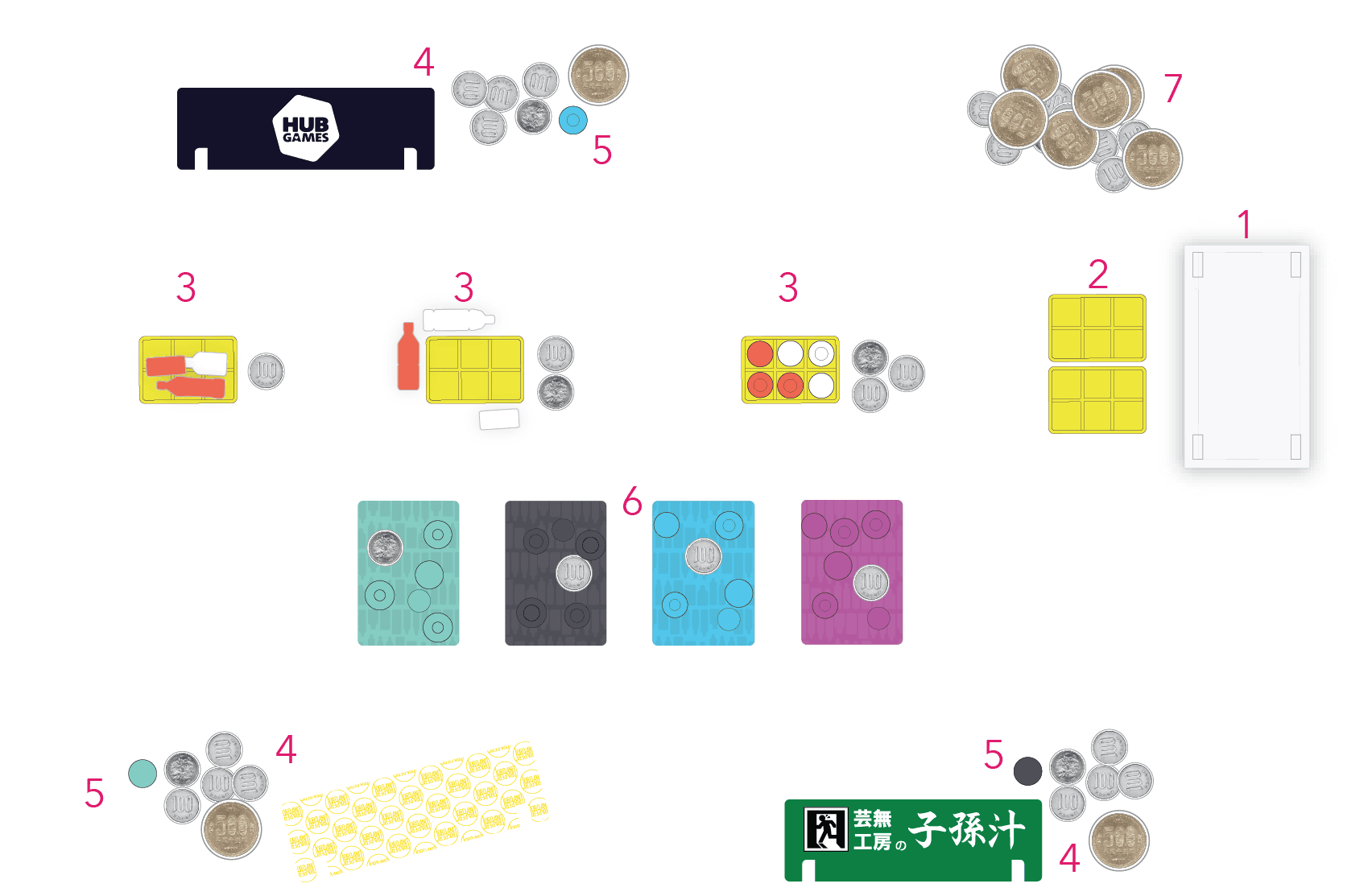
SETUP: 1 - Place an empty crate at the top of the table, then turn the vending machine upside down and place it on top of the crate. 2 - Place two empty crates in front of the vending machine, then place three crates in a row down the center of the table. 3 - Pick two drink colors, take all of those drinks, and arrange these in the order of the diagram below: 1st drinks not in slots with 100 yen above, 2nd drinks around crate with 200 yen above, and 3rd drinks in slots with 300 yen above. 4 - Give each player 1,000 yen, and have them pick an ad sign. 5 - Place all remaining drinks in the four other colors in the box lid, and have each player randomly pull a drink from it, placing it in front of them. 6 - Place the four color stock cards matching the drinks in the box lid on the table, with 1x 100 yen coin on each. Take the drinks out of the box lid and place them on top of their matching color stock card. 7 - Place the rest of the yen in a pile as the bank.
GAMEPLAY: The game consists of three phases each round, a bidding phase, betting phase, and selling phase.
Bidding Phase: All yen is open information, except for during the bidding phase. During this phase players take a secret amount of yen into a fist, and have a blind bid. Players who don’t win the bid keep their yen. If any players tie for the highest bid, they will take all of their yen back to their supply, and then engage a new bid again with the other tied player(s). This continues until there is a winner. The highest bidder then pays their entire bid to the bank, and may purchase up to two stocks. Stocks are the drinks on top of the color stock cards. If the winning bidder chooses to purchase stock(s), they pay the amount of yen on the stock card to the bank, and take a drink of that color, placing it in front of them. You may only purchase two different colors if purchasing two stocks. If any stocks are purchased, place 100 yen from the bank onto their stock color card.
Betting Phase: During the betting phase, all players may place a bet on one of the three categories on the table: Drinks landing perfectly in slot, drinks landing outside of the crate, or drinks landing in the crate but not in slot. To place a bet, put your vending ad next to the bet type you wish to make, and place either 1 or 2 100 yen coins on your ad. If you place a single 100 yen coin, you are betting at least a single drink will meet this condition after dropped in the vending machine, and if you place two 100 yen coins, you are betting both of the drinks dropped in will end up in your bet position.
*Example: P1 places a bet of 100 yen on the “out of crate” bet spot, signifying they are betting at least one drink will land outside of the crate. P2 places 200 yen on the "in the crate, but not in a slot" bet spot, signifying they think both of the drinks dropped will end up this way. P3 places 100 yen on the “drink in slot” bet spot, signifying they think at least single drink will land perfectly in a crate slot.

Bets are placed starting with the player who won the blind bid for the round, and continue clockwise. Next the blind bid winner will choose two drinks from the stock supply (drinks on top of the stock color cards), and drop them into the opening in the upside down vending machine. The drinks chosen must be two different colors, and exactly two drinks will be chosen. The player will then slowly lift up the vending machine to reveal the outcome. *If any drinks become stuck in the vending machine and have not landed somewhere when revealed, they will be dumped out of the vending machine and returned to their original stock card with no outcome.
Any bets that were correct will pay out from the bank based on their bet type (the amount to be paid out per 100 yen is indicated by the yen above the bet type). Any incorrect bets will be paid to the bank.
*Example continued: The result of this round is that one drink landed in the crate, but not in a slot, and one drink landed outside of the crate. This means that P1 who bet 100 yen on a single drink landing outside of the crate wins, and receives their initial bid back plus 200 yen from the bank. P2 who bid 200 yen on “inside the crate but not in slot wins the bid on their first 100 yen, but loses on their second, as only a single drink met the condition. They get their initial 100 yen back and 100 yen from the bank for winning, but lose their second 100 yen bid to the bank. P3 bid on in slot, and as no drinks filled this condition, they lose all of their bid to the bank.
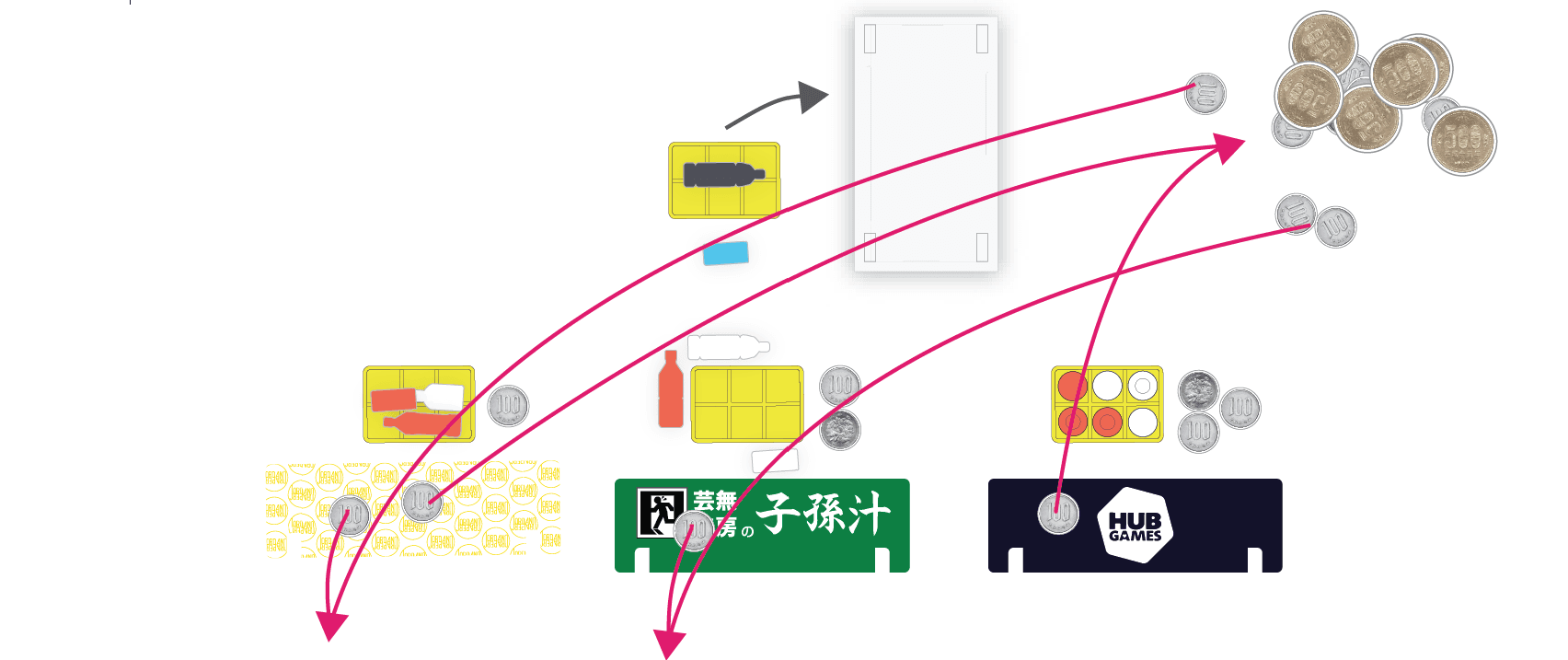
Any drinks that landed in the crate, regardless of if they were in a slot or not, will be added to the two empty crates in front of the vending maching. Then place 100 yen from the bank onto their color stock card. Any drinks that landed outside of the crate are simply returned to their color stock card.
Selling Phase: Now all players have the opportunity, starting with the blind bid winner of the round and going clockwise, to sell any stocks they wish back to the corresponding stock color card. The amount paid for these drink stocks is simply the amount of yen currently on that stock card. The amount is paid from the bank. There is no limit to the number of stocks that can be sold.
GAME END: After the selling phase, check for one of the two endgame conditions: Either all 12 slots of the two crates in front of the vending machine have been filled, or two stock color cards no longer have drinks on them. If either of these conditions has been met, continue to Endgame Scoring. If neither of them have been met, start again with the bidding phase and repeat through the three phases once more.
Endgame Scoring: Once the game has ended, all players will sell their stocks at the value of yen on the corresponding color stock card. They will return their drinks sold to the card and take yen from the bank as they do so. Then add all of your yen together, and the player with the most yen is the winner!
Rulebook Editing: Travis D. Hill
METRO DRINKS
- Designer
- JORDAN DRAPER
- Games required
- TOKYO METRO & TOKYO JIDOHANBAIKI
TOKYO JIDOHANBAIKI can be used as an expansion to TOKYO METRO, creating a new experience titled METRO DRINKS. By adding the stock cards from JIDOHANBAIKI as a new action card column, as well as the ability to build vending machines at stations for extra income, METRO DRINKS gives TOKYO METRO a new layer of depth, strategy, and fun!
Use all of the regular rules of TOKYO METRO, with the following additions:
SETUP:
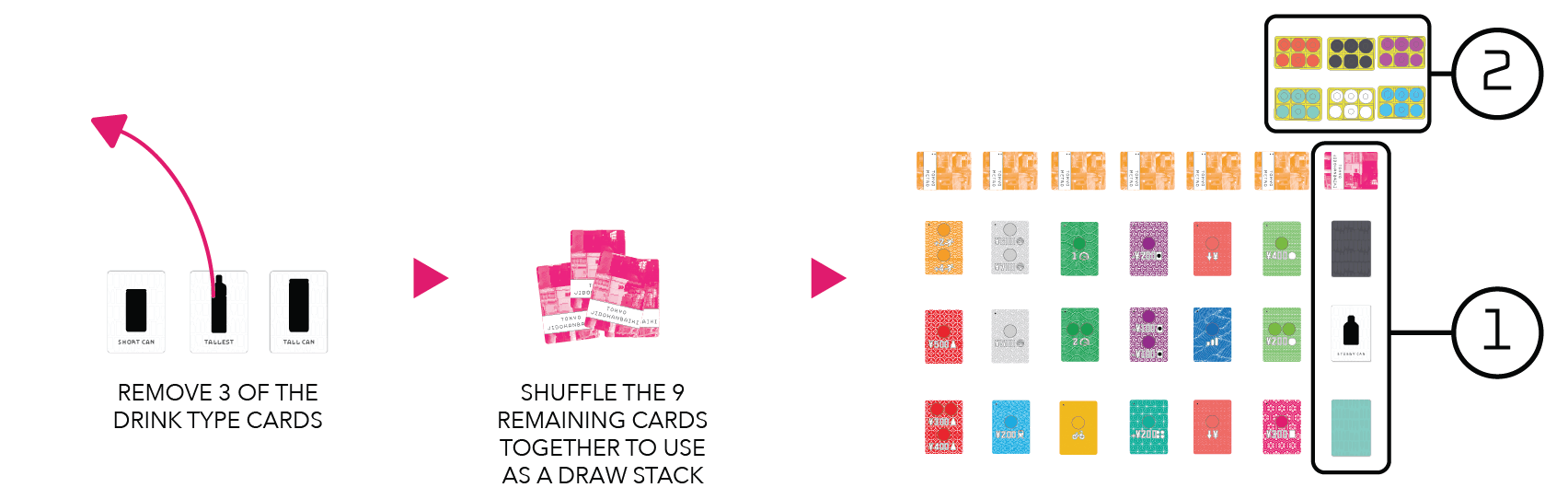
- 1 - Take the 12 stock cards from TOKYO JIDOHANBAIKI, remove any 3 of the drink type cards, shuffle the remaining 9 cards (6 color & 3 drink type) together, and place them face down as an extra column of action cards.
- 2 - Place the 6 crates above the JIDOHANBAIKI stock cards, filling each one with a set of drinks from a single color.
ACTION CARDS:
The new column of action cards offers 3 new actions to be taken:
DRINK COLORED CARDS: These cards allow for a set of 6 same-colored drinks to be taken, in exchange for the permanent removal of 1 of your action discs for the remainder of the game. To take this action, place your action disc back into the box, take an available color card, and the matching drink crate.
BUILD A VENDING MACHINE STATION: Place your action disc on top of the JIDOHANBAIKI draw stack, then place a drink at a station you are touching that already has a station pyramid there, and no other drink. This action disc will come back to you at the end of the phase like normal. There is no limit to the number of times this action may be taken each phase. If you build at a station you do not own, you must pay the owner 100 yen the first time you build at one of their stations, 200 for the 2nd time, 300 for the 3rd, etc.
DRINK TYPE CARDS: Only one player may take this action each action phase. Place your action disc onto the card, then take an unlimited number of free ‘build a vending machine’ actions until phase end. You must still pay other players when building at their stations. Take your disc back as normal.
STATION PAYOUTS:
When a train triggers payout for a station with a drink, the owner will receive yen from the bank. The amount of yen paid depends on the number of drinks of that color they have on the map in total:
- 1-3 drinks: 100 yen is paid when a station with that drink color is hit
- 4-5 drinks: 200 yen is paid when a station of that drink color is hit
- 6 drinks: 300 yen is paid when a station of that color is hit
EXTRA RULES:
There is no limit to how many drink colors a player may own.
It is allowed to ‘build a vending machine station’ as you walk past a station, as long as you touch it. Thus it is possible to take the ‘drink type card action’, then a move action, building multiple drink stations as you take your movement.
It is not allowed to build a vending machine station while riding on a train; you must exit first.
MR.SUDSY VEND
- Players
- 2-6
- Time
- 45-60 MIN
- Designer
- JORDAN DRAPER, LUKE CRANE
- Game type
- JARP
- Games required
- TOKYO COIN LAUNDRY & TOKYO JIDOHANBAIKI
By adding the vending machine from TOKYO JIDOHANBAIKI to the Mr.Sudsy Laundromat, it is possible to purchase detergent during the game.
SETUP: Place the vending machine in the laundromat, and all excess detergent next to it.
PURCHASING DETERGENT: During your time in the laundromat, you can attempt to purchase detergent by spending 200 yen, and dropping a detergent bottle that is next to the vending machine inside. If the detergent comes out, you may keep it. If it gets stuck, it will remain in the vending machine until it is knocked out by another detergent bottle.
After players use detergent to start their wash cycles, they should discard the used detergent bottles next to the vending machine so they may be purchased again.
VEND MACHINE
- Players
- 2-6
- Time
- 15-30 MIN
- Designer
- JR HONEYCUTT, JORDAN DRAPER
- Game type
- TACTICAL APPLIANCE WARFARE
- Games required
- TOKYO COIN LAUNDRY & TOKYO JIDOHANBAIKI
Vend Machine incoporates new terrain and a vending machine unit into Wash Machine.
SETUP: Follow all of the regular rules in Wash Machine, with the following added terrain:
SIGNS: Slide sets of vending signs together in a V shape, and place them around the arena.
CRATES & DRINKS: Fill the six crates with all 36 drinks sorted by color, give each player 3, and have them place them in a chain, 1 bedsheet apart, starting from the notepad.

The vending machine may now be drafted as a new unit! This also opens up a way to play the game with 3 parties, drafting with 6 points instead of 8. The vending machine has the following stats and abilities:
6 VENDING MACHINE: 6pts. / 6hp / triangle move / vend attack.
The vending machine has no basic attack, but instead uses collected ammo (drinks) to take a special vend attack. When the game starts, the vending machine must pick up ammo by moving and touching a crate full of drinks. When the vending machine ends its movement touching a crate, take all drinks from inside. On a later turn, instead of moving, you make a take a shot with the vending machine by dropping any number of collected ammo into the vending machine. As the ammo rolls from the front of the machine, each drink that hits an enemy unit counts as a normal shot, and damage will be calculated just as a standard attack would be, separately for each drink that hits. Any used drinks are returned to their original crate after the shot is finished.
IZAKAYA
- Players
- 2-5
- Time
- 30 MIN
- Designer
- JORDAN DRAPER
- Games required
- TOKYO JUTAKU, TOKYO JIDOHANBAIKI & TOKYO METRO
IZAKAYA is a game about building a city with corner shops that mixes together JUTAKU, JIDOHANBAIKI, and METRO.
Setup: Shuffle the Jutaku cards and create a grid based on the number of players. Use the more difficult white side.
- 2-3 Players: Create a 3x3 grid. flip the center card to the blue side - it cannot be used.
- 4 Players: Create a 4x4 grid
- 5 Players: Create a 5x5 grid
Place one site card on its easy blue side to the left of the grid. Place all Jutaku pieces above the grid, and one architect token to the side of them. Take all 6 of the color stock cards from JIDOHANBAIKI, and place them in a row below the grid. Then, place a crate below each stock card, filled with all 6 drinks of that specific color.
Place one of the shape stock cards from JIDOHANBAIKI face down to the right of the row. Place 100 yen coins on the left two color cards, 200 yen on the middle two color cards, and 300 yen on the right two color cards. Give each player 6 pyramids and 9 matching discs of the same color from METRO, and 1,000 yen. Using players’ remaining disc, randomly draw them 1 at a time, and create a turn order row next to the grid.
only three of the nine discs will be used to take actions with.

Gameplay: The game consists of two phases: bidding for turn order and taking actions.
Bidding for turn order: Decide the amount of yen you wish to bid and secretly place it in a closed fist. All reveal simultaneously. Whoever bid highest goes first, next-highest second, etc… Adjust the turn order track, and place all yen used to bid into a separate pile. Players who tied with their bids swap positions in turn order.
Action phase: In turn order, players will place 1 of their 3 discs on an action spot:
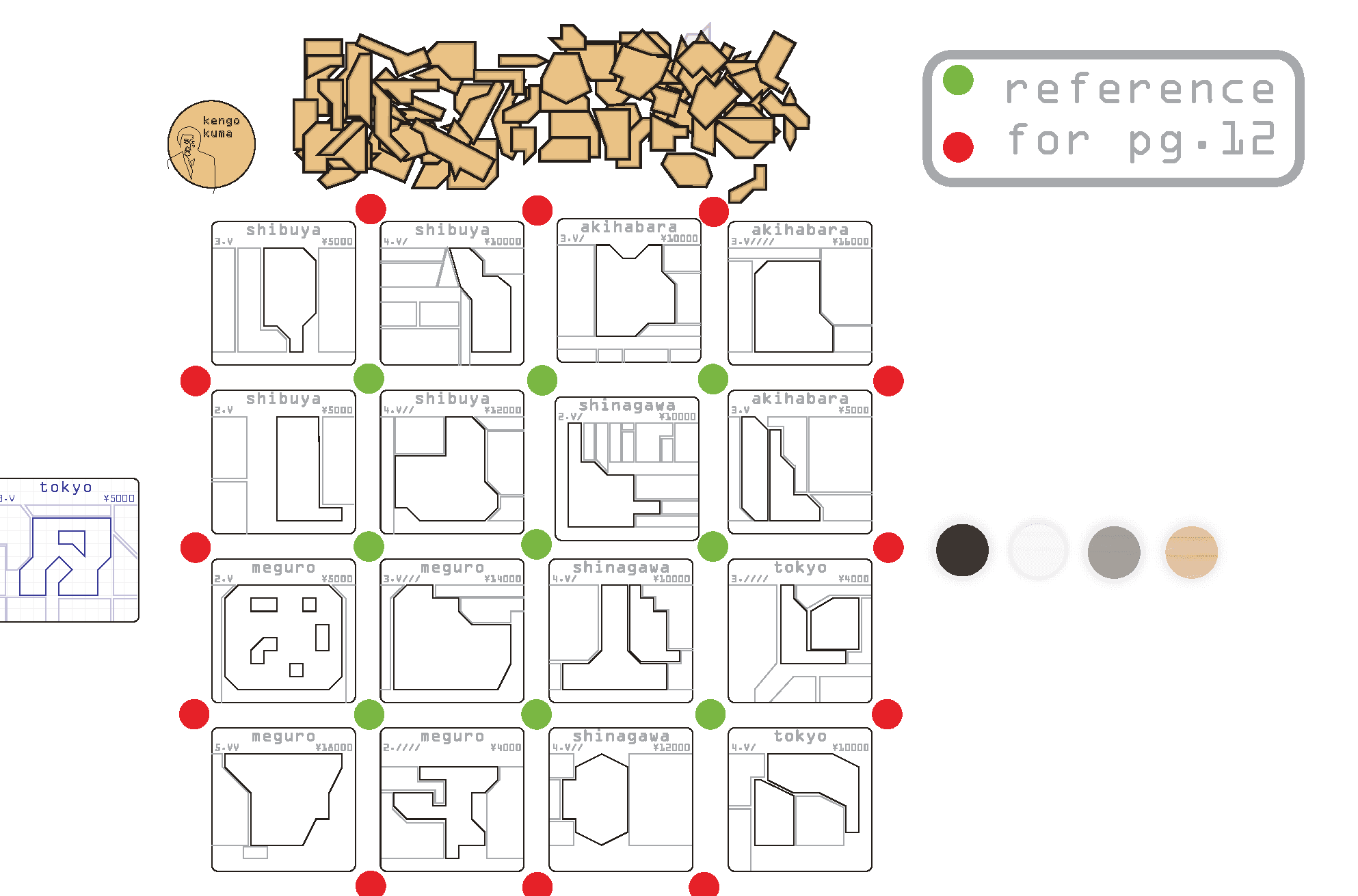
Colored bottle spot: Place your disc on a color stock card, take one of the drinks in that crate, and place it at a corner intersection between cards. Only one disc may be placed on each color per action phase. All 4 card intersection spots (shown in green on pg.11) must have drinks before any 2 card intersection spots (shown in red) may be chosen. It is never possible to place drinks on a single outside card corner that is not shared with another card.
Price adjustment spot: Place your disc on the face-down JIDOHANBAIKI card, then move a single 100 yen coin from a color stock card to a different color stock card. Only one disc may be placed on this action spot per action phase.
Site claiming: Place your disc on the blue site card. Then, place one of your six discs in the space between the edges of two site cards.
Finally, place one of your pyramids on a site card sharing a side with the previously-placed disc. Only one player may occupy each site card. There is no limit to the number of players that can use the site claiming action each action phase. If a player manages to get a straight line of 3 action discs (only possible in the 4 or 5 player games), they get to take a building piece from the supply and place it immediately anywhere they wish for free, following the normal building rules of JUTAKU.
Build action: Place your disc on the architect token, then take a single building piece (it is not allowed to test the piece out; it must be chosen first), and place it onto any site card that you wish, following the normal building rules of JUTAKU. If there are two dark site borders on a card, they may both be used as separate buildings. There is no limit to the number of build actions that can be taken each action phase.
Action round end: After all players have placed their 3 action discs and performed actions, return the action discs to their owners and begin a new auction round.
Game End: The game end is triggered when a certain amount of yen is met or exceeded while bidding for turn order. After the designated amount is reached, players take one more action phase. The game ends when the total amount of yen meets or exceeds: 1,500 yen for 2 players / 2,300 yen for 3 players / 3,000 yen for 4 players / 4,000 yen for 5 players.
Scoring: Each player scores points based off of their buildings and the values of the drinks directly adjacent to them. Sum the total yen amount of each bottle touching your building. Multiply that total with the number of floors built on your building.
Example: The grey colored player has a building with 3 floors and 3 drinks on the corners of the site card. They count up the sum total of all of the drinks touching the site card, and then multiply that by the number of floors (3). So if there were 2 white drinks (at market value of 200), and 1 blue drink (at market value of 300), the player multiplies their 3 story building by 700 yen, taking a payment of 2,100 yen. After players score all of their buildings, they add their total yen amounts as their score.
The player with the most yen is declared the winner! If there is a tie, the player who kept the most of their starting yen wins.
ARCHITECTS ALSO SHOP
- Players
- 2-5
- Time
- 30 min
- Designer
- Stefan Brakman, Jordan Draper
- Game type
- Pick-up & Deliver, Dexterity (Optional)
- Games required
- TOKYO JIDOHANBAIKI, TOKYO TSUKIJI MARKET, TOKYO JUTAKU & TOKYO COIN LAUNDRY
In this game you are a Japanese architect, on a shopping spree for a plethora of the most expensive items you can manage to grab!
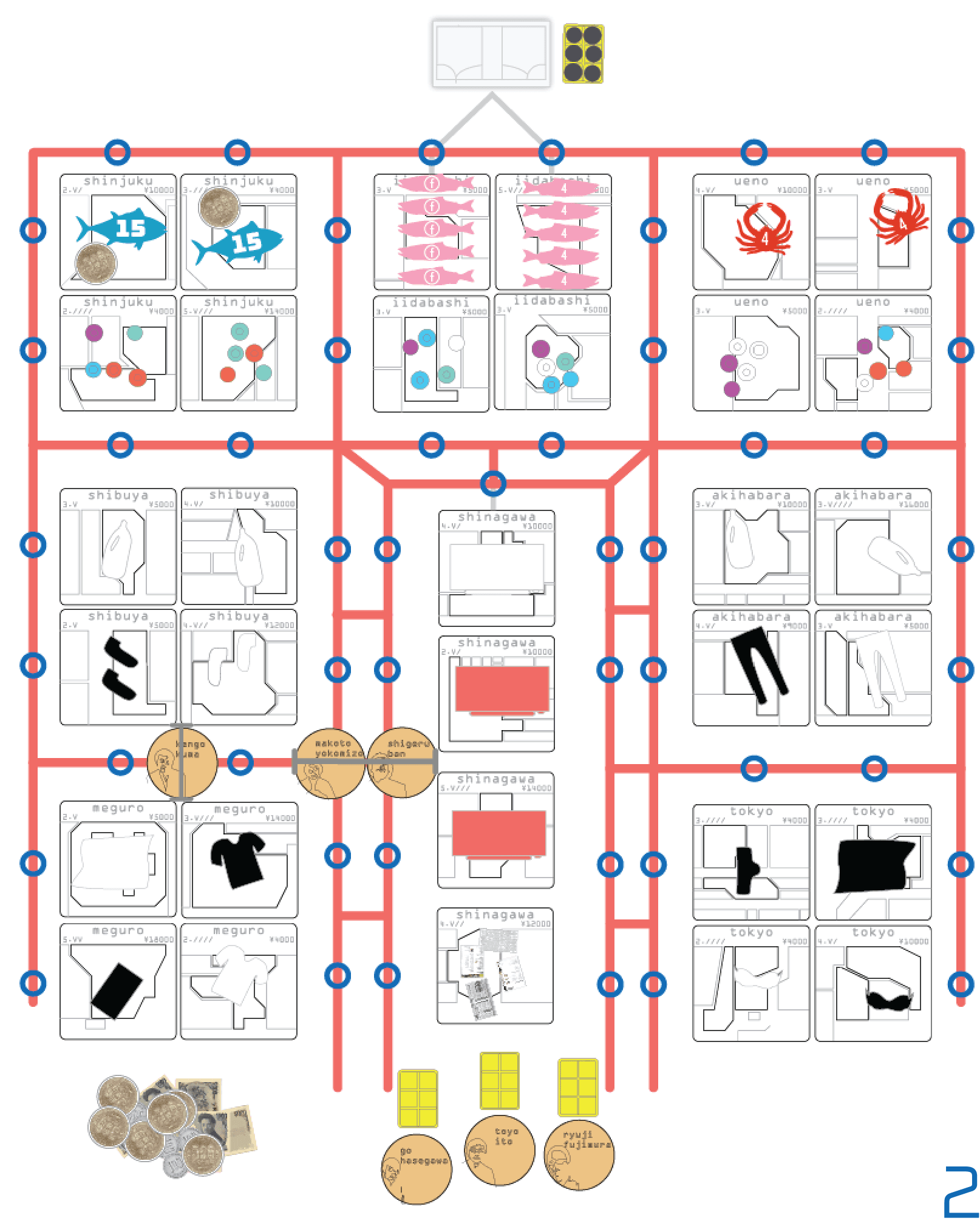
SETUP: Take the Jutaku cards and create a grid as shown on page 24. Note the width of the pathways should be gauged by the architect tokens.
- 1) Place the vending machine, and one crate with all 6 black drinks next to it.
- 2) Pull the rest of the drinks randomly from a box lid, until there are 5 on each of the cards on the second to top row.
- 3) Place the 6 color drink cards out, with 300 yen on all but the black, which gets 200.
- 4) Give each player an empty crate, and an architect token, at the bottom of the map.
- 5) Place magazines/newspapers on the bottom middle card, 2 washing machines and a dryer on the top 3 center cards.
- 6) Place one clothing item on each of the lower outside 16 cards. Note that socks are a single item.
- 7) Place a washer and dryer card in a stack with 500 yen.
- 8) Place the bed sheet and pillow case card in a stack with 400 yen.
- 9) Place the shirt and pants card in a stack with 300 yen.
- 10) Place the bra, underwear, and socks card in a stack with 200 yen.
- 11) Place two ‘15’ tuna and 500 yen on the top left most cards, with the other tuna in the bag.
- 12) Place 5 salmon on each of the top two middle cards.
- 13) Place two ‘4’ crabs on the top right most cards, with the other crabs in the bag.
- 14) Place mackerel barrels equal to 3x the number of players next to the cards.
- 15) Place yen as a general supply somewhere.
GAMEPLAY: There are two options for playing the game, with dexterity, or without. Decide as a group which version you would like to play. With the dexterity version, you will have to add items to your shopping basket, and once added, you may not touch them anymore and must push your basket using your architect token. If anything falls out, it is discarded as lost. With the strictly economic version, there is no pentaly for items falling out and you may touch everything in your basket as you wish.
The player to last go shopping will go first, then play will follow in clockwise order. On your turn you must move between 1-3 spaces (shown by the blue dots on page 19), and then you may take 1 item from a card you are directly in front of (or use the vending machine if touching it). From a blue dot location, you may move to any other blue dot connected by a line with no other blue dots between as shown on page 19. This is 1 space. You may make a 180 degree U-turn as a movement, but you may not end your turn on the same space you started on.
Begin moving through the shopping center, grabbing as many items as you can manage, and when you are ready, make your way back to the entrance at the bottom of the map. You may only exit out the double lanes in the center. You will exit the store with your lot of goods a total of two times. When you exit, take the items, a mackerel barrel, and a payout for each as shown by the market prices. Place the items in front of you. Then reduce yen on cards you were paid out for by 100 yen only, regardless of the number of items you took in that category. On your next turn, enter the store again at the middle double lanes.
EXAMPLE: You exit the store first with two shirts, a red drink, a salmon, and a crab pulled from the bag. Nice haul. You take 600 yen for the two shirts, removing 100 yen from that card stack. You take 300 yen for the red drink, and take 100 yen from the red card. You place the salmon with the ‘f’ side up in front of you and take 500 yen. You place the ‘6’ crab you pulled from the bag in front of you, and take 600 yen. Your turn is now over and you will enter the store again on your next turn.
While most items have a direct payout price, some are special as follows:
NEWSPAPERS/MAGAZINES: These are used as tie-breakers, and the player with the most will break any end game ties.
DETERGENT: Each detergent you exit the store with will double the value of a single clothing item payout. EXAMPLE: You leave the store with 2 bras, 1 shirt, and 2 detergent. You choose to apply the first detergent to the shirt, incresing the payout from 300 to 600, and the second to a bra, increasing the payout from 300 to 600. You may not apply multiple detergent to a single item.
CRABS: Instead of taking a crab from a card, you instead pull one from the bag randomly.
TUNA: First, you must have 500 yen and pay it to the bank, then pull a random tuna from the bag. Each tuna you purchase after the first will cost +500 yen.
SALMON: Take a salmon from the card, and if you are the first player out of the store, you will get 500 yen per salmon and place them with the ‘f’ side up. If any player (including yourself) has already left the store with any salmon, take 400 yen per salmon and place them with the ‘4’ side up.
VENDING MACHINE: To use the vending machine, you must be at one of the two blue locations shown with grey lines touching the vending machine. Dump the entire crate of black drinks in the vending machine. Take all drinks that come out, and remove any stuck drinks and place them back in the crate next to the machine. If any drinks are paid out, or dropped from carts, add them to the vending machine crate (or next to it if full).
GAME END: When all but one player have 2 mackerel barrels from exiting the store 2 times, the game will end immediately. The player left in the store will not receive any payout for current cart items.
Count up all of your yen, and the player with the most is the winner! If there is a tie, the player with the most magazines/newspapers wins. If there is still a tie, you are all consumers.
BOTTLE BONUS!
- Players
- 2-8
- Time
- 20-30 min
- Games required
- TOKYO JUTAKU & TOKYO JIDOHANBAIKI
BOTTLE BONUS is a variation of TOKYO JUTAKU that uses pieces from JIDOHANBAIKI.
This game plays exactly as TOKYO JUTAKU does. After each round ends, before moving, the player who completed their building from the round will take a number of drinks randomly from the box equal to the number of other players. They will then drop those drinks into the vending machine all at once, and all other players may grab up to 1 drink that comes out of the vending machine.
These drinks now grant a special one-time use power to the players who grabbed them, based on the specific drink color as follows:
BLACK: Spend this drink to flip over your site card before you start building on it. Players cannot look at the back side before deciding to flip or not.
WHITE: Spend this drink and then place 1 piece on your site card before the round begins.
MINT: At any time during the round, spend your mint drink and yell ‘put it back’. All other players must put back the piece they are currently using, or the last one they placed, and take a different piece from the supply.
BLUE: Spend this drink before one round of building. If you win that round, keep this drink next to your site cards for +200 yen (¥) at game end. If you do not win this round, discard this drink.
RED: Spend this drink to move 2 pieces at the same time for this round only. You will still only grab one piece at a time, but you may freely arrange it and one other piece on your building simultaneously.
PURPLE: During the move phase, spend this drink to move to any available site card on the map, ignoring regular movement rules.
CHOCOLATE MILK
- Players
- 2-8
- Time
- 15-25 MIN
- Designer
- JORDAN DRAPER
- Game type
- ECONOMIC MARKET
- Games required
- TOKYO JIDOHANBAIKI (2 copies for 7-8 players) & TOKYO JUTAKU
Chocolate milk utilizes a player-controlled market, along with set collection and selling, to try to profit the most from the vending craze across Tokyo.
SETUP: Take 9 site cards from TOKYO JUTAKU and arrange them into a 3x3 grid. Give each player an architect token. Place all of the drinks on the table (if playing with 7-8, only use drinks from a single copy of the game). Place the 6 colored stock cards in a row, and the 6 shape stock cards in a row below that. Randomly place one drink on all of the outer site cards, and 2 drinks on the center card, along with every player’s architect token. Give each player 500 yen. Place the vending machine at the top of the grid. Give each player a crate, and place any remaining crates next to the vending machine.
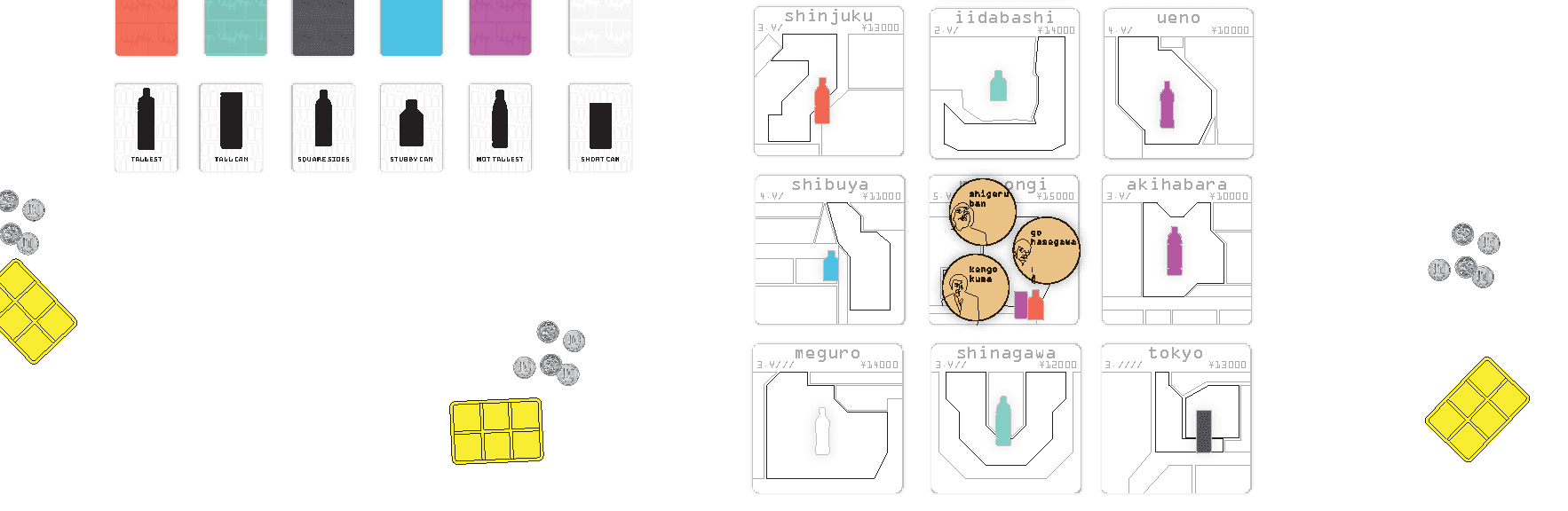
GAMEPLAY: Whoever used a vending machine last is the starting player. On your turn you may do 1 of 3 things:
- Move 1 space away (vertically, horizontally, or diagonally), and purchase a drink for 100 yen. Drop the drink into the vending machine. If it comes out, place it into a crate you own. Then place 100 yen onto the corresponding stock color card, and stock shape card, of the drink you purchased. (For a more strategic game, do not use the vending machine, and immediately receive the drink purchased.)
- Sell drinks to the supply. You will receive payment for the drinks based on a single stock card market price (eg blue, tallest, stub, etc.). The price on the card will be paid for each drink you sell that matches the attribute. Return the sold drinks back to the supply, and then return all yen from the stock card back to the bank.
USING THE SELL ACTION, THIS PLAYER SELLS 2 MINT DRINKS TO THE SUPPLY AT 200 YEN EACH. THE MINT STOCK CARD THEN RESETS TO 0 YEN.
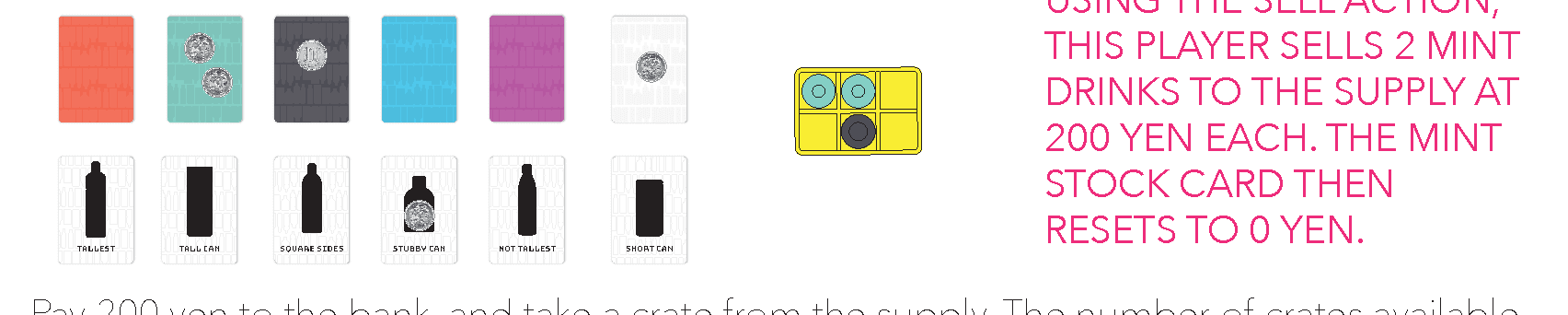
- Pay 200 yen to the bank, and take a crate from the supply. The number of crates available for purchase will vary, based on the number of players and copies of JIDOHANBAIKI in use. With an extra crate, it is possible to hold more than 6 drinks, and to score both crates separately for set collection at game end.
REFRESH: If a player uses the move action, immediately replace their purchased drink with a new one by either randomly pulling a drink from the supply, or if you have a die, roll for the color (using the stock cards as reference starting on the left) and then for shape (using the stock cards again). If a color or shape is no longer in the supply, simply move to the next available option shown on the stock card to the right.
ROLL TO REFRESH A PURCHASED DRINK. IF YOU ROLL A 3 AND THEN A 6, THE BLACK SHORT CAN WOULD COME OUT. IF THERE IS NO BLACK SHORT CAN, THE BLACK TALLEST WOULD COME OUT, AND SO ON.
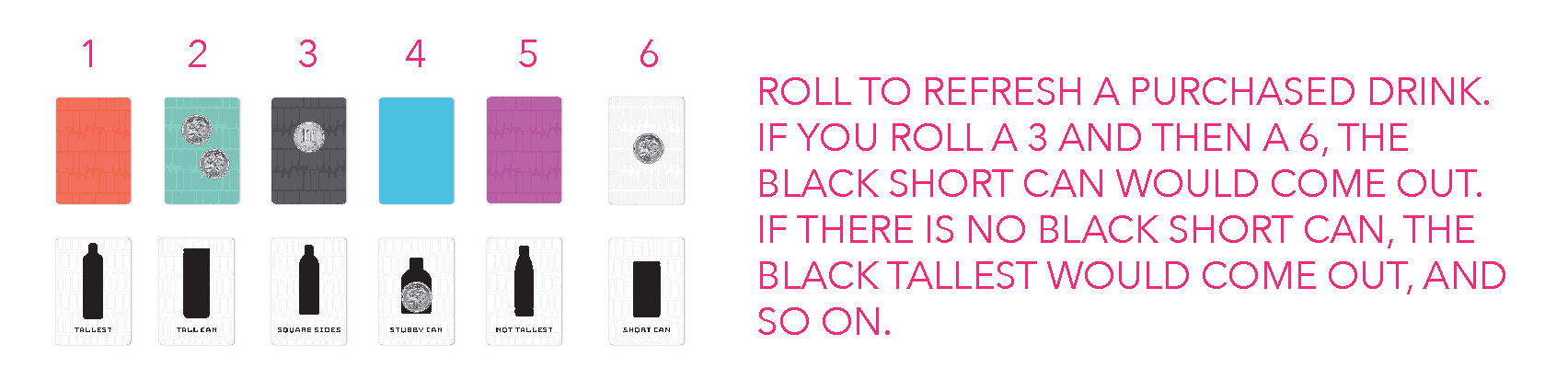
GAME END: The game ends when any player has 6 of the same type or color of drink in one of their crates, or a player has at least 2,000 yen.
SCORING: Each crate is scored separately, and may only be scored for either a single color or a single drink shape. Each player chooses a single attribute (i.e. the color red or stub cans) and then counts the number of drinks matching that attribute in their crate. Multiply it by itself and receive a payout. For example, 5 mint drinks would be 5x5 = 2,500 yen in payout.
Add your personal yen to the payout you receive from crates, and the player with the most yen is declared the winner!
FAQ
For Pura's 500 yen action, must all drinks that come out of the vending machine go onto one stock card, or does each go to its own matching card? Each drink that comes out is placed on a stock card matching that drink, so the drinks from one drop can spread across several cards (three white and three black drinks would go to the white and black cards respectively). The action exists to clear a whole crate of mismatched drinks at the risk of some getting stuck in the machine.
In Pura, does freely rearranging the crates allow moving drinks between them, or only the crates themselves? Only the crates themselves: you may rearrange and rotate crates as often as you like, but the drinks inside stay put. Drinks move between crates only by spending a 100 yen coin to swap drinks straight across between one side of a crate and the adjacent side of a neighboring crate.
In Genmaicha, does the losing bidder also pay their bid, and can one drink's two ingredient uses be spread across different recipes? All players pay their bids to the bank; the bid sets only the order of choosing crates, and with one crate per player everyone receives one, so there is no losing bidder. Each drink can be used as two ingredients (shape or color), even in separate recipes, but never for the same condition twice; drinks used in a recipe are discarded back to the bag or box, while unused drinks carry over.
Is there a trick to dropping drinks so they stick in the vending machine, and how often should drinks actually stick? Sticking is meant to be a rare occurrence rather than a constant one. With 1 or 2 drinks dropped together the chance of one sticking averages about 10 to 15 percent, and dropping more drinks in at once raises the chance.
In Crate Wars, what do the turn options do, how can more than six drinks end up at one crate, and how do drinks move between crates? On your turn you take one of three actions: place a single drink from your supply on a stock card adjacent to a crate on your side; spend a 500 yen coin to drop all placed drinks from one stock card on your opponent's side into the vending machine (any that come out return to that card, any that do not are discarded); or spend a 500 yen coin to return all placed drinks from one of your own stock cards to your supply; you may instead pass, which ends your actions and discards your remaining supply. More than 6 drinks can end up at one crate because both players' drinks committed to that matchup go into the crate when it is claimed, and the winner chooses which extras beyond 6 to discard. Drinks never move between crates: they only leave a stock card through the two 500 yen actions.
In Grape Soda, may you only move your own drinks, and does a jump replace your normal move? Yes on both counts: you may only place or move drinks of your own color, and a jump takes the place of the one space move. You jump over one or more drinks of another color and collect them, provided you have a space to land in on the other side and you do not jump over a drink of your own color.
How are the drink stickers applied, what are the leftover stickers for, and are any required for play? Start every sticker from the left side and wrap it around so the ends overlap. Of the leftovers, the rectangular sticker fits the recess on the front of the vending machine and the rest are purely decorative; none of the stickers are necessary for game play.