Living rulebook
Ceramic
BEAD TRADE
Game Design by: Jordan Draper Built by: Rachel Butterfield &
Jordan Draper
9+ 3-5 15m
Since the beginning of recorded history, beads of every size, shape, and color have been woven into the fabric of the global economy. From the markets of rural India to the courts of kings, from Native American regalia to the jewels of English royalty, beads have carried extraordinary perceived value, even to this day.
In Bead Trade, each player begins with a spirit animal and a set of four unique beads tied to it. Through real-time open trading and storytelling, you'll swap beads and shift their market value by hiding them beneath ceramic boxes.
REMAINING BEADS P2 P3
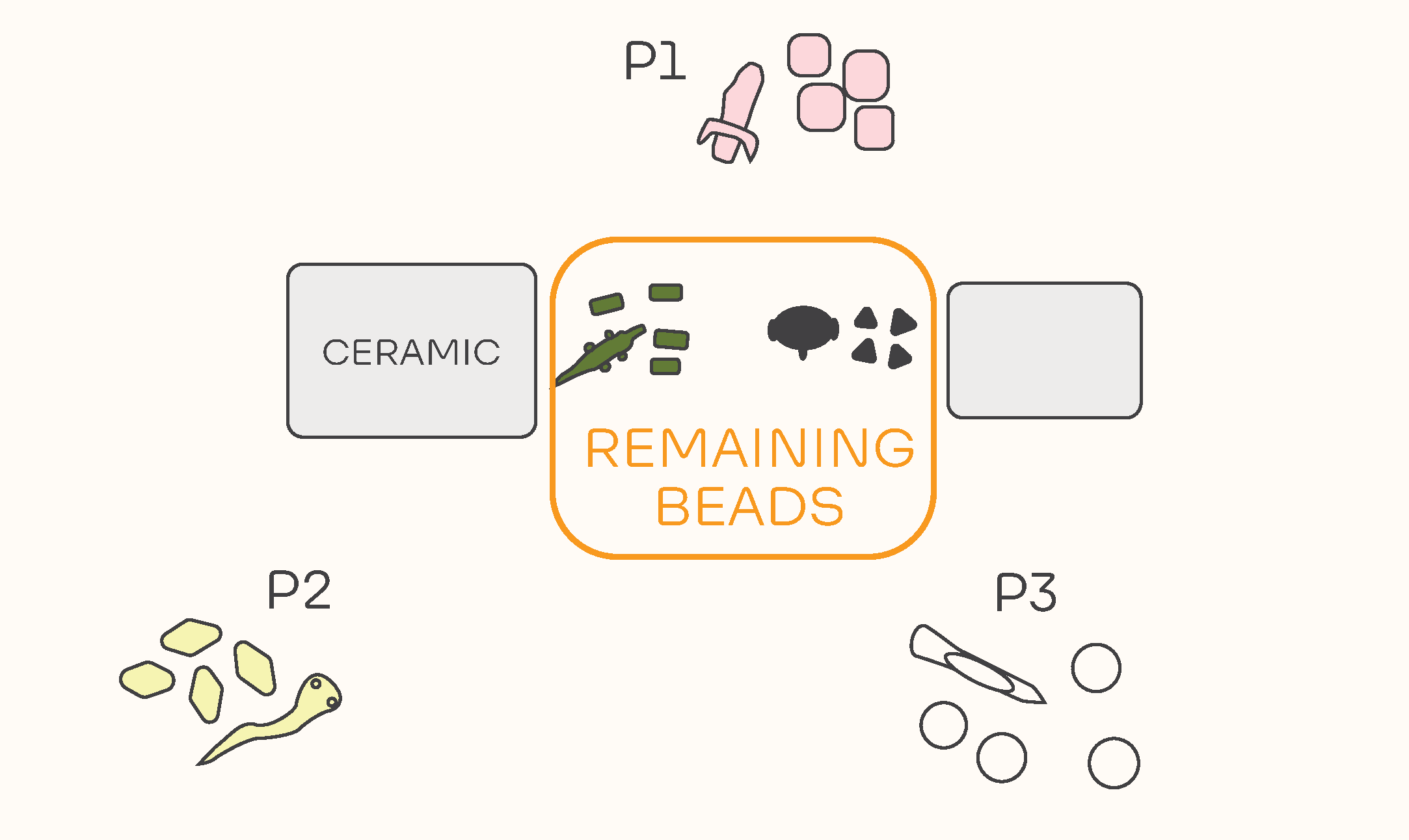
SETUP Give each player one spirit animal and the matching set of beads. Note that your copy of the game may have different spirit animals, colors, or bead shapes than those shown in the illustrations. Place the box top and box bottom face down in the middle of the table where everyone can reach them, with any remaining beads and spirit animals in the center between the two boxes.
OBJECTIVE Hold the highest-scoring combination of beads and spirit animals when the game ends. Each piece's value depends on how beads of that type are distributed under and on top of the two boxes.
GAME END The game ends immediately once two spirit animals in total have been placed on top of the game boxes (in any combination between the two).
GAME START Bead Trade takes place in real time, there are no turns. The youngest player says "let's begin" when everyone is ready, and from that moment until the game-end condition is met, players may freely discuss, barter, trade, and swap beads.
TRADING WITH PLAYERS You can trade any of your starting beads, or even your spirit animal, with any other player. Trades do not need to be equal in value or quantity, you might trade three beads for two, or a spirit animal for a single bead. Players decide among themselves what they're willing to exchange, and storytelling is highly encouraged. Try to convince others why your beads are valuable by weaving a story around them. You can continue trading any new pieces you acquire, and you may well finish the game holding none of your starting components.
TRADING WITH THE CENTER If you're playing with fewer than 5 players, the extra beads and spirit animals are placed in the center between the two game boxes. Any player may trade a single bead from their possession for any single bead in the center, one for one. Spirit animals may also be swapped one for one with spirit animals in the center, but beads may never be traded for spirit animals (or vice versa). You may only make one center trade at a time, you must place the bead or spirit animal you just received in front of you before initiating another. The center always contains the same total number of beads and spirit animals it started with; only the colors, shapes, and types may change.
KEEPING BEADS SECRET You may keep your beads and spirit animal hidden in your hand, or place them in front of you for others to see. The choice is entirely up to each player and may change at any time.
ASSIGNING VALUE At any point during the game, any player may place any number of beads from their possession under either game box. Beads placed under the box top (marked "CERAMIC") increase the chances of that bead type having a positive value at scoring. Beads placed under the box bottom increase the chances of that bead type having a negative value. Once beads are placed under a box, they stay there for the rest of the game, you may not retrieve them or peek underneath for any reason. Any player may also place a spirit animal they possess on top of either the box top or the box bottom at any time, up until the game-end condition is met. Beads may continue to be placed under a box even after a spirit animal has been set on top of it.
GAME END SCORING As soon as the game-end condition is met, all players reveal their beads and spirit animals in front of them for everyone to see. Score as follows:
Scoring: Resolve each bead type in any order. First, check whether a matching spirit animal sits on the box top or box bottom (steps 1 and 2). If it does, score that bead type accordingly and move on, do not also score it from the box reveal in step 3. Only bead types whose spirit animal is not on either box are scored from the box reveal.
1 - Spirit animal on the box top. If a player holds any beads matching a spirit animal placed on the box top, they score 1 point, unless they are the only player with that bead type, in which case they score 0. A player can score at most 1 point per matching bead type, regardless of how many copies of that bead they hold. 2 - Spirit animal on the box bottom. If a player holds any beads matching a spirit animal placed on the box bottom, they score −1 point, even if they are the only player with that bead type. A player can lose at most 1 point per matching bead type, regardless of how many copies of that bead they hold.
3 - Reveal the boxes. Lift the box top and box bottom to reveal the beads hidden underneath (spirit animals are never placed under boxes). For each bead type, compare how many are under the top versus the bottom: More under the top than the bottom: Every player holding any beads of that type scores 1 point. A player who holds the matching spirit animal scores an additional 1 point (even if they hold no beads of that type). Exception: If only one player at the table holds any piece of that type (counting both the beads and the matching spirit animal), that lone player scores 0 for it. Equal under top and bottom: No points are scored for that bead type or spirit animal. More under the bottom than the top: Every player holding that bead type or its matching spirit animal scores −1 point, even if they are the only player with it. A player can lose at most 1 point per bead type, even if they hold both the bead and its matching spirit animal.
Center pieces don't count. Beads and spirit animals left in the center between the two boxes do not affect scoring in any way.
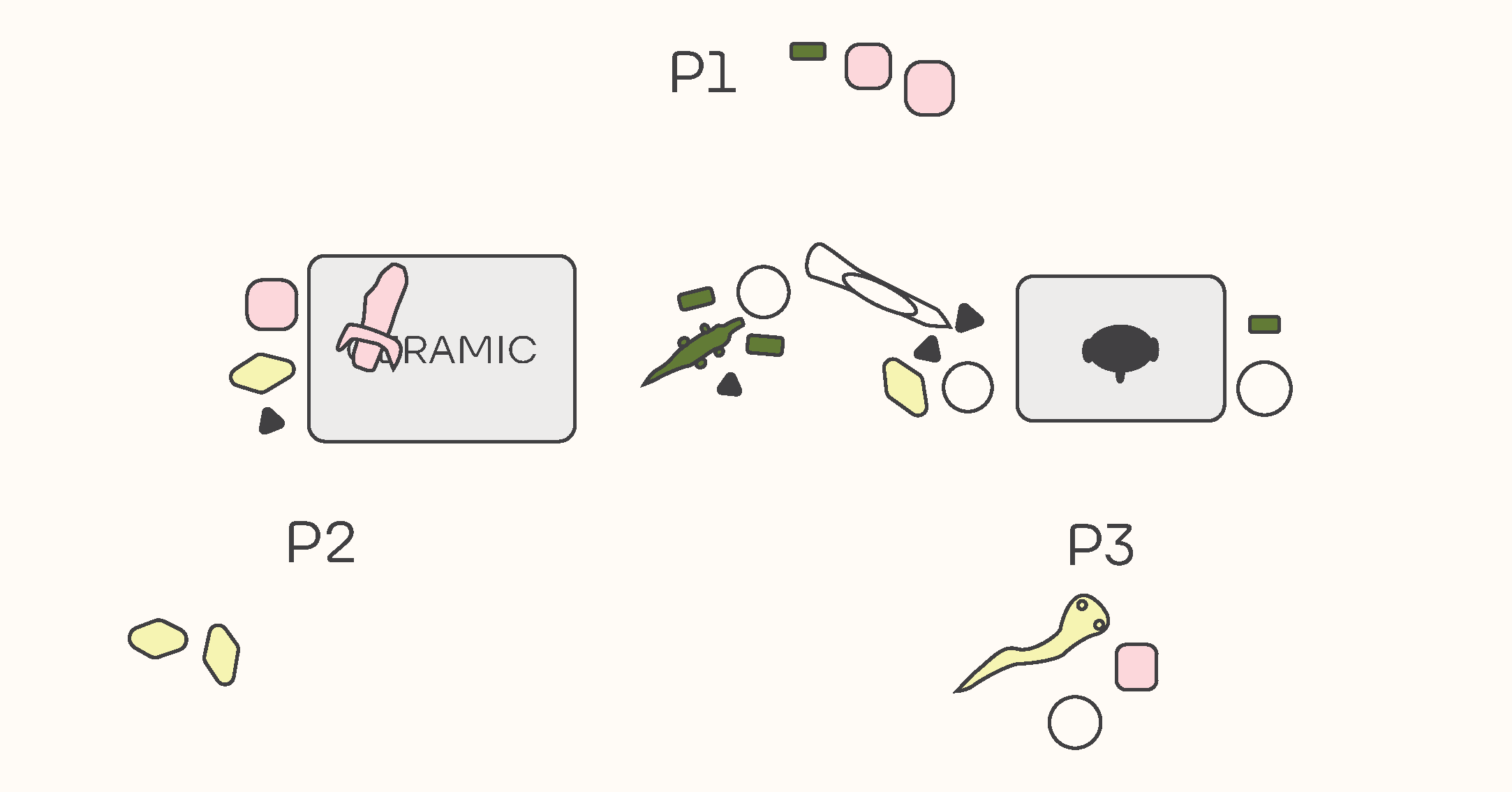
EXAMPLE P1 scores 1 point for their pink beads (the pink bull spirit animal is on the box top), and −1 point for their green bead (more green beads were placed under the box bottom than the top). Total: 0 points. P2 scores 1 point for their yellow beads, because more yellow beads are under the box top than the bottom and P3 holds the yellow snake spirit animal, meaning P2 is not the only player with that bead type. Total: 1 point. P3 scores 1 point for their pink bead and an additional 1 point for their yellow snake spirit animal (because more yellow beads are under the box top than the bottom), and −1 point for their white bead (which had more copies under the box bottom than the top). Total: 1 point.
SCORE TABLE Piece held Matching spirit Matching spirit More of that More of that Equal under by player animal on animal on bead type bead type top and box TOP box BOTTOM under TOP* under BOTTOM* bottom*
Bead +1 -1 +1 -1 0
Spirit +1 (bonus,
- - in addition -1 0
animal to bead score)
*Only applies if the matching spirit animal is not on either box.
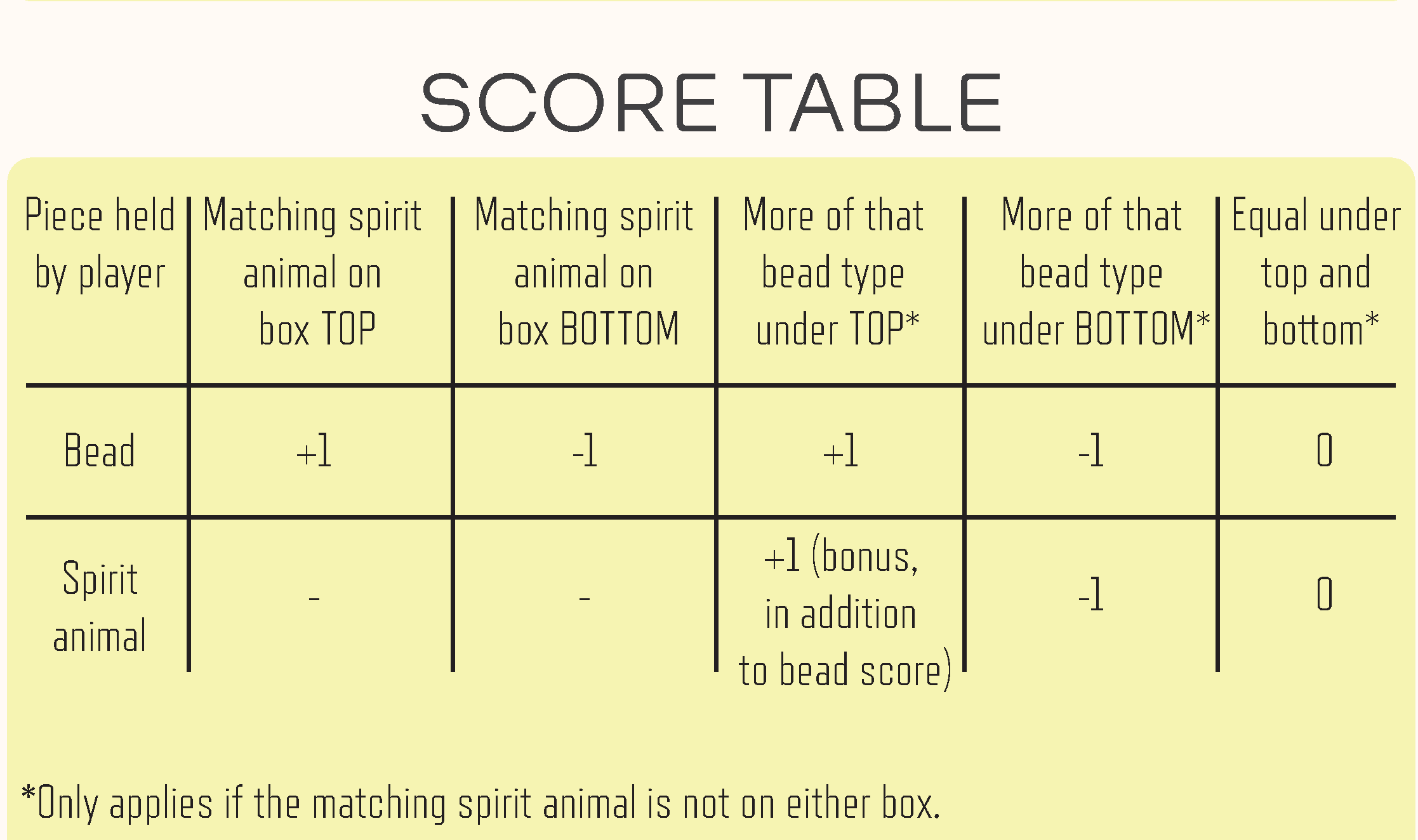
Notes: Maximum of 1 point (positive or negative) per bead type when a spirit animal is on a box. In the box-reveal “more under the top” case, up to 2 positive points are possible if a player holds both the bead type and the matching spirit animal. Negative points are always limited to −1 per bead type, even if the player holds both the bead and its matching spirit animal. Each bead type is scored only once: either from a spirit animal on a box, or from the box reveal, never both. Sole-holder exception: positive points only. If you are the only player at the table holding any piece of a given type (bead or matching spirit animal), you score 0 instead of a positive value for it. Negative points still apply to sole holders.
DETERMINING THE WINNER The base game consists of three rounds. At the end of each round, write down every player’s score on the score table. After scoring, reset the game (see RESET below) and play again. The player with the highest combined score across all three rounds is the winner. RESET (after each round): Return every bead and spirit animal to its starting owner (each player receives their original spirit animal plus the four matching beads of that type). Place any extra beads and spirit animals back in the center. Empty both boxes completely (remove all beads that were placed underneath and any spirit animals that were placed on top). The game is now ready for a new round.
VARIATIONS ・LOCKED SPIRITS: After a spirit animal is placed on a box, it is not allowed to place beads under that box any longer. ・NORMAL SPIRITS: Spirit animals held by players at game end count only as a regular bead of their matching type, they do not grant the additional +1 bonus when more of that bead type is under the box top. ・LONGER SPIRITS: Three spirit animals must be placed on boxes to trigger game end. ・EXTENDED SPIRITS: Play over five rounds, keeping score, to determine the winner of the game. ・STORY ANIMALS: Before the game starts, players tell the story of their spirit animal and beads. TWO-PLAYER VARIANT: For a two-player game, give each player two spirit animals and the two matching sets of four beads each (eight beads total per player). Place the remaining beads and spirit animal in the center between the two boxes. Play the rest of the game as normal.
JORDANDRAPER.COM